
Join Our JEE Preparation Group
Prep with like-minded aspirants; Get access to free daily tests and study material.
Sign in
Please select an account to continue using cracku.in
↓ →
Join Our JEE Preparation Group
Prep with like-minded aspirants; Get access to free daily tests and study material.
If $$C_r \equiv {}^{25}C_r$$ and $$C_0 + 5 \cdot C_1 + 9 \cdot C_2 + \ldots + (101) \cdot C_{25} = 2^{25} \cdot k$$, then $$k$$ is equal to ___________.
Correct Answer: 51
We are asked to evaluate the expression
$$S \;=\; C_0 \;+\; 5\,C_1 \;+\; 9\,C_2 \;+\;\cdots\;+\;(101)\,C_{25},$$
where $$C_r \equiv {}^{25}C_r$$ denotes the binomial coefficient “25 choose r”.
First notice the pattern of the numerical multipliers. Writing out the first few terms we have
$$1 = 4\cdot 0 + 1,\quad 5 = 4\cdot 1 + 1,\quad 9 = 4\cdot 2 + 1,\quad\ldots,\quad 101 = 4\cdot 25 + 1.$$
Hence the general term is $$4r + 1$$ when the binomial coefficient is $$C_r$$. Therefore we can rewrite the sum compactly as
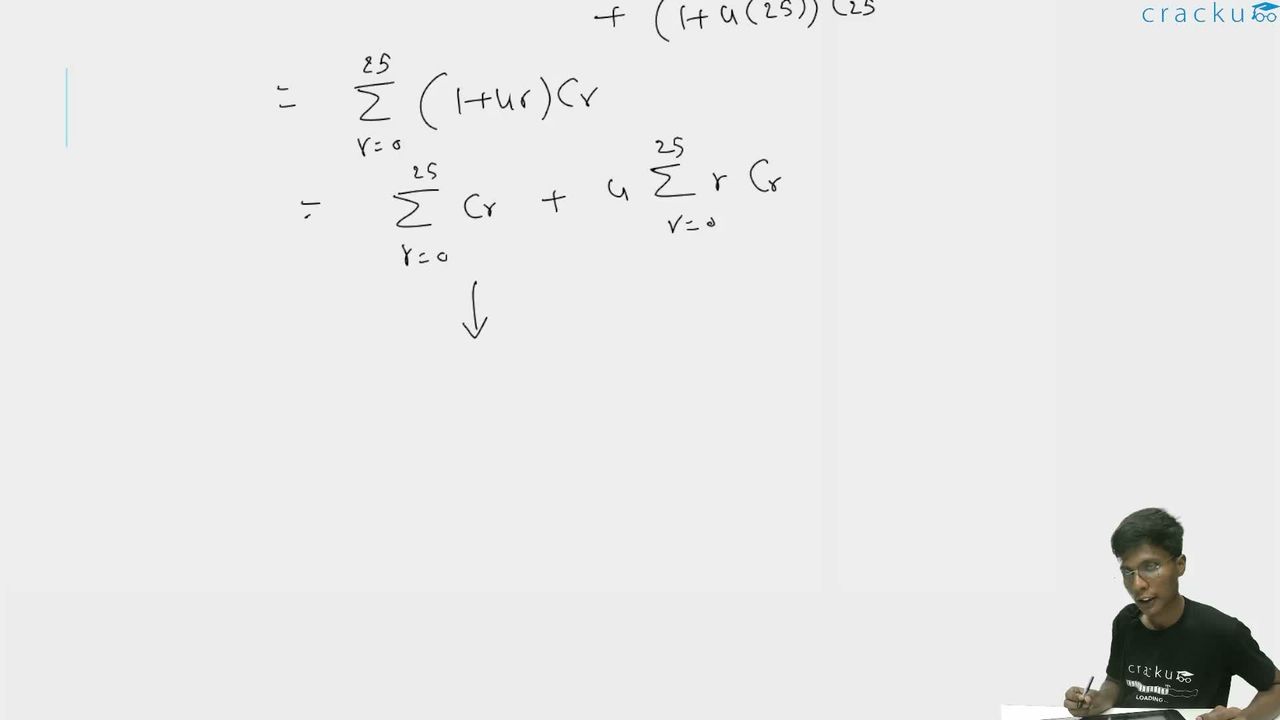
$$S \;=\;\sum_{r=0}^{25} (4r + 1)\,C_r.$$
Now we split the factor $$(4r + 1)$$ into two simpler pieces:
$$4r + 1 \;=\; 1 \;+\; 4r.$$
Substituting this back into the summation gives
$$S \;=\;\sum_{r=0}^{25} 1\cdot C_r \;+\; 4\sum_{r=0}^{25} r\,C_r.$$
We shall evaluate the two sums separately.
1. The first sum $$\displaystyle\sum_{r=0}^{25} C_r$$ is the well-known expansion of $$(1 + 1)^{25}$$ by the binomial theorem. Explicitly, the theorem states
$$(x + y)^n \;=\;\sum_{r=0}^{n} {}^{n}C_r\,x^{n-r}y^{\,r}.$$
Putting $$x = 1,\;y = 1,\;n = 25$$ gives
$$\sum_{r=0}^{25} C_r \;=\;(1 + 1)^{25} \;=\;2^{25}.$$
So
$$\sum_{r=0}^{25} C_r = 2^{25}.$$
2. The second sum $$\displaystyle\sum_{r=0}^{25} r\,C_r$$ can be obtained by differentiating the binomial expansion. Start with $$(1 + x)^{25} = \sum_{r=0}^{25} {}^{25}C_r x^{\,r}.$$ Differentiate both sides with respect to $$x$$:
$$25(1 + x)^{24} = \sum_{r=1}^{25} r\,{}^{25}C_r x^{\,r-1}.$$
Now set $$x = 1$$ to obtain
$$25(1 + 1)^{24} = \sum_{r=1}^{25} r\,C_r\,1^{\,r-1}.$$
Simplifying,
$$25 \cdot 2^{24} = \sum_{r=1}^{25} r\,C_r.$$
(The $$r = 0$$ term is zero anyway, so the upper limit could remain 25.) Thus we have the standard identity
$$\sum_{r=0}^{25} r\,C_r = 25\cdot 2^{24}.$$
Returning to our expression for $$S$$, we now substitute these two evaluated sums:
$$S \;=\; \left(\sum_{r=0}^{25} C_r\right) \;+\; 4\left(\sum_{r=0}^{25} r\,C_r\right) \;=\; 2^{25} \;+\; 4\bigl(25\cdot 2^{24}\bigr).$$
Compute the second term carefully:
$$4\bigl(25\cdot 2^{24}\bigr) \;=\; 100\cdot 2^{24}.$$
Hence
$$S \;=\; 2^{25} \;+\; 100\cdot 2^{24}.$$
Factor out the common power $$2^{24}$$:
$$S \;=\; 2^{24}\bigl(2 + 100\bigr) \;=\; 2^{24}\cdot 102.$$
We are told in the question that $$S = 2^{25}\,k.$$ Therefore equate the two expressions for $$S$$:
$$2^{24}\cdot 102 \;=\; 2^{25}\,k.$$
Divide both sides by $$2^{25}$$ to isolate $$k$$:
$$k \;=\;\frac{2^{24}\cdot 102}{2^{25}} \;=\;\frac{102}{2} \;=\;51.$$
So, the answer is $$51$$.
Was this solution helpful?
Click on the Email ☝️ to Watch the Video Solution
Create a FREE account and get:
_1.webp)

Educational materials for JEE preparation

Ask our AI anything

AI can make mistakes. Please verify important information.
AI can make mistakes. Please verify important information.
