
Join Our JEE Preparation Group
Prep with like-minded aspirants; Get access to free daily tests and study material.
Sign in
Please select an account to continue using cracku.in
↓ →
Join Our JEE Preparation Group
Prep with like-minded aspirants; Get access to free daily tests and study material.
Let $$\vec{a}, \vec{b}$$ and $$\vec{c}$$ be three vectors such that $$|\vec{a}| = \sqrt{3}$$, $$|\vec{b}| = 5$$, $$\vec{b} \cdot \vec{c} = 10$$ and the angle between $$\vec{b}$$ and $$\vec{c}$$ is $$\frac{\pi}{3}$$. If $$\vec{a}$$ is perpendicular to the vector $$\vec{b} \times \vec{c}$$, then $$\left|\vec{a} \times (\vec{b} \times \vec{c})\right|$$ is equal to ___________.
Correct Answer: 30
We have the data
$$|\vec a|=\sqrt3,\qquad |\vec b|=5,\qquad \vec b\cdot\vec c=10,\qquad\text{angle between }\vec b\ \text{and}\ \vec c=\frac{\pi}{3}.$$
First we determine $$|\vec c|.$$ From the definition of the dot product,
$$\vec b\cdot\vec c=|\vec b|\,|\vec c|\cos\frac{\pi}{3}.$$
Substituting the given numbers,
$$10=5\cdot|\vec c|\cdot\frac12\;\Longrightarrow\;|\vec c|=\frac{10}{5}\cdot2=4.$$
Now we use the fact that $$\vec a\perp(\vec b\times\vec c).$$ Because $$\vec b\times\vec c$$ is perpendicular to both $$\vec b$$ and $$\vec c,$$ the condition $$\vec a\cdot(\vec b\times\vec c)=0$$ tells us that the three vectors $$\vec a,\vec b,\vec c$$ are coplanar; hence we may place them conveniently in the same plane without loss of generality.
Choose a right-handed coordinate system so that
$$\vec b=(5,0,0),$$
and let $$\vec c$$ make an angle $$\frac{\pi}{3}$$ with $$\vec b$$ inside the $$xy$$-plane. Using $$|\vec c|=4$$ and $$\cos\frac{\pi}{3}=1/2$$, we write
$$\vec c=(4\cos\tfrac{\pi}{3},\,4\sin\tfrac{\pi}{3},\,0)=(2,\,2\sqrt3,\,0).$$
Then
$$\vec b\times\vec c=\begin{vmatrix} \hat i & \hat j & \hat k\\[4pt] 5 & 0 & 0\\[4pt] 2 & 2\sqrt3 & 0 \end{vmatrix}=10\sqrt3\,\hat k=(0,0,10\sqrt3).$$
Because $$\vec a\perp(\vec b\times\vec c)$$ and the cross product is along the $$z$$-axis, $$\vec a$$ has no $$z$$-component. Write
$$\vec a=(x,y,0),\qquad x^2+y^2=|\vec a|^2=(\sqrt3)^2=3.$$
We need $$\bigl|\vec a\times(\vec b\times\vec c)\bigr|.$$ Before substituting numbers, recall the vector triple-product formula
$$\;\vec a\times(\vec b\times\vec c)=\vec b\,(\vec a\cdot\vec c)-\vec c\,(\vec a\cdot\vec b)\;. $$
Compute the two dot products:
$$\vec a\cdot\vec b=(x,y,0)\cdot(5,0,0)=5x,$$
$$\vec a\cdot\vec c=(x,y,0)\cdot(2,2\sqrt3,0)=2x+2\sqrt3\,y.$$
Hence
$$\vec a\times(\vec b\times\vec c)=\bigl[\,\vec b\,(2x+2\sqrt3\,y)\bigr]-\bigl[\,\vec c\,(5x)\bigr].$$
Substituting $$\vec b=(5,0,0)$$ and $$\vec c=(2,2\sqrt3,0)$$ gives
$$\vec a\times(\vec b\times\vec c)=\bigl(5,0,0\bigr)(2x+2\sqrt3\,y)-\bigl(2,2\sqrt3,0\bigr)(5x).$$
Multiplying out each term separately,
$$\vec b\,(2x+2\sqrt3\,y)=(10x+10\sqrt3\,y,\,0,\,0),$$
$$\vec c\,(5x)=(10x,\,10\sqrt3\,x,\,0).$$
Subtracting,
$$\vec a\times(\vec b\times\vec c)=\bigl(10\sqrt3\,y,\, -10\sqrt3\,x,\,0\bigr) =10\sqrt3\,(y,-x,0).$$
The magnitude is therefore
$$\bigl|\vec a\times(\vec b\times\vec c)\bigr| =10\sqrt3\,\sqrt{y^{2}+x^{2}} =10\sqrt3\,\sqrt{3} =10\cdot3=30,$$
because $$x^{2}+y^{2}=3.$$ Notice that the result is independent of the particular directions of $$\vec a$$ inside the plane, so the value $$30$$ is unique.
So, the answer is $$30$$.
Was this solution helpful?
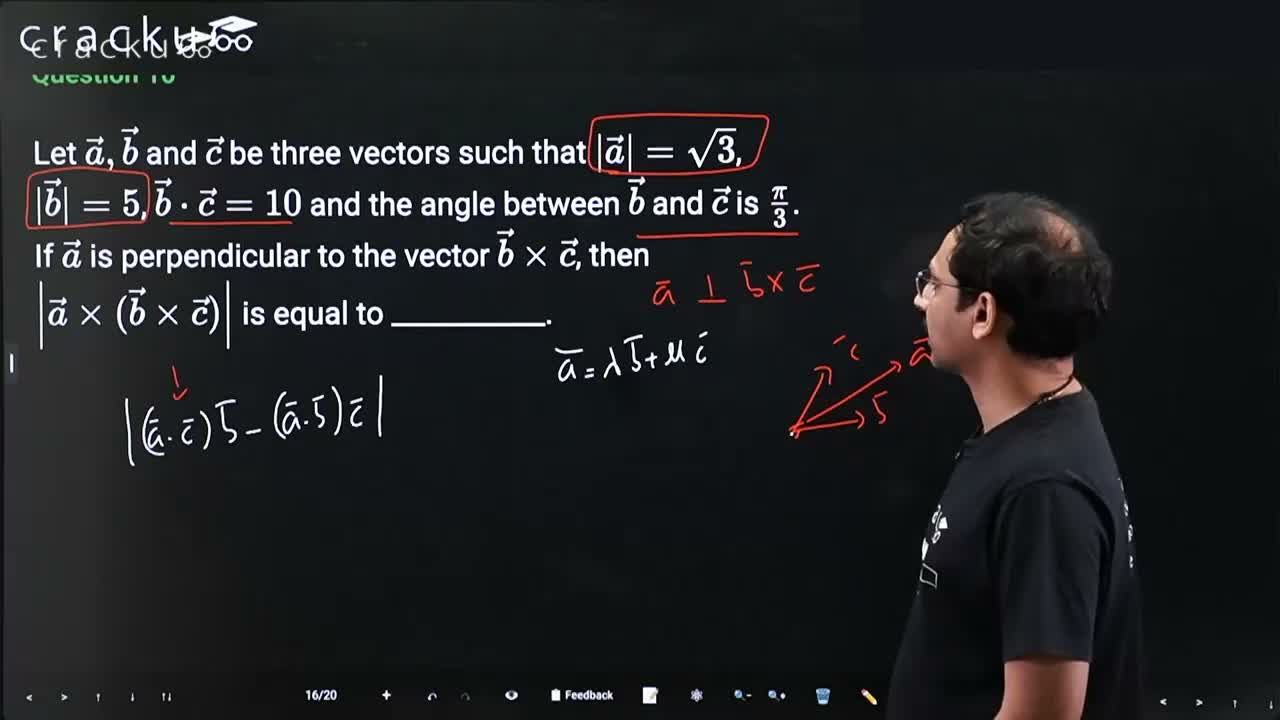
Click on the Email ☝️ to Watch the Video Solution
Create a FREE account and get:
_1.webp)

Educational materials for JEE preparation

Ask our AI anything

AI can make mistakes. Please verify important information.
AI can make mistakes. Please verify important information.
