
Join Our JEE Preparation Group
Prep with like-minded aspirants; Get access to free daily tests and study material.
Sign in
Please select an account to continue using cracku.in
↓ →
Join Our JEE Preparation Group
Prep with like-minded aspirants; Get access to free daily tests and study material.
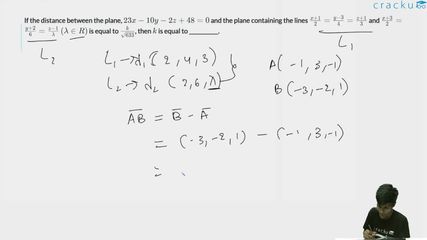
If the distance between the plane, $$23x - 10y - 2z + 48 = 0$$ and the plane containing the lines $$\frac{x+1}{2} = \frac{y-3}{4} = \frac{z+1}{3}$$ and $$\frac{x+3}{2} = \frac{y+2}{6} = \frac{z-1}{\lambda}$$ $$(\lambda \in R)$$ is equal to $$\frac{k}{\sqrt{633}}$$, then $$k$$ is equal to ___________.
Correct Answer: 3
We have to find the perpendicular distance between the fixed plane $$23x-10y-2z+48=0$$ and the (yet unknown) plane that contains the two given straight lines
$$\dfrac{x+1}{2}=\dfrac{y-3}{4}=\dfrac{z+1}{3}\qquad\text{and}\qquad\dfrac{x+3}{2}=\dfrac{y+2}{6}=\dfrac{z-1}{\lambda},\;(\lambda\in\mathbb R).$$
First, we check when these two lines actually lie in one plane. For that they must either be parallel or intersect. Their direction vectors are
$$\vec d_1=(2,\,4,\,3),\qquad\vec d_2=(2,\,6,\,\lambda).$$
They are not proportional (unless $$\lambda$$ took three different values at once), so they are not parallel. Hence they must intersect for coplanarity.
A convenient condition for two lines with direction vectors $$\vec d_1,\vec d_2$$ and position vectors of any two points $$\vec a_1,\vec a_2$$ to intersect is
$$\bigl(\vec a_2-\vec a_1\bigr)\cdot(\vec d_1\times\vec d_2)=0.$$ This comes from the fact that the vector joining the two points must be perpendicular to the normal of the plane formed by the two direction vectors.
Taking the point corresponding to parameter $$r=0$$ on the first line gives $$P_1(-1,\,3,\,-1)$$, and the point corresponding to parameter $$s=0$$ on the second line gives $$P_2(-3,\,-2,\,1).$$ Thus
$$\vec a_1=(-1,\,3,\,-1),\qquad\vec a_2=(-3,\,-2,\,1),\qquad \vec a_2-\vec a_1=(-2,\,-5,\,2).$$
Now we compute the cross-product of the direction vectors:
$$ \vec d_1\times\vec d_2= \begin{vmatrix} \mathbf i & \mathbf j & \mathbf k\\ 2 & 4 & 3\\ 2 & 6 & \lambda \end{vmatrix} =\bigl(4\lambda-18,\,-(2\lambda-6),\,4\bigr) =\bigl(4\lambda-18,\,-2\lambda+6,\,4\bigr). $$
The intersection condition is therefore
$$(-2,\,-5,\,2)\cdot(4\lambda-18,\,-2\lambda+6,\,4)=0.$$
Carrying out the dot product step by step,
$$\begin{aligned} &(-2)(4\lambda-18)+(-5)(-2\lambda+6)+2(4)=0,\\ &\;-8\lambda+36+10\lambda-30+8=0,\\ &\;2\lambda+14=0,\\ &\;\lambda=-7. \end{aligned}$$
Thus the two lines intersect when $$\lambda=-7$$, and hence for this value they lie in a single plane.
With $$\lambda=-7$$ we fix the two line directions as
$$\vec d_1=(2,\,4,\,3),\qquad\vec d_2=(2,\,6,\,-7).$$
The normal vector of the required plane is given by their cross-product (already evaluated above, now with $$\lambda=-7$$):
$$\vec n=\vec d_1\times\vec d_2=(-46,\,20,\,4).$$
Notice that $$\vec n=2(-23,\,10,\,2)=-2(23,\,-10,\,-2),$$ so it is a scalar multiple of $$\vec n_1=(23,\,-10,\,-2),$$ the normal of the given fixed plane. Therefore the two planes are parallel, as expected.
Using point $$P_1(-1,\,3,\,-1)$$ and normal vector $$\vec n_1=(23,\,-10,\,-2)$$ (any non-zero scalar multiple will do), the equation of the plane containing the two lines is obtained from the point-normal form
$$23(x+1)-10(y-3)-2(z+1)=0.$$
Simplifying term by term,
$$23x+23-10y+30-2z-2=0,$$ $$23x-10y-2z+51=0.$$
Thus we have two parallel planes:
$$\Pi_1:\;23x-10y-2z+48=0,\qquad \Pi_2:\;23x-10y-2z+51=0.$$
The distance between two parallel planes $$Ax+By+Cz+D_1=0$$ and $$Ax+By+Cz+D_2=0$$ is given by the formula
$$d=\frac{|D_2-D_1|}{\sqrt{A^2+B^2+C^2}}.$$
Substituting $$D_1=48,\;D_2=51,\;A=23,\;B=-10,\;C=-2,$$ we get
$$ d=\frac{|51-48|}{\sqrt{23^2+(-10)^2+(-2)^2}} =\frac{3}{\sqrt{529+100+4}} =\frac{3}{\sqrt{633}}. $$
The distance is stated in the question as $$\dfrac{k}{\sqrt{633}}$$, so $$k=3$$.
So, the answer is $$3$$.
Was this solution helpful?
Click on the Email ☝️ to Watch the Video Solution
Create a FREE account and get:
_1.webp)

Educational materials for JEE preparation

Ask our AI anything

AI can make mistakes. Please verify important information.
AI can make mistakes. Please verify important information.
