
Join Our JEE Preparation Group
Prep with like-minded aspirants; Get access to free daily tests and study material.
Sign in
Please select an account to continue using cracku.in
↓ →
Join Our JEE Preparation Group
Prep with like-minded aspirants; Get access to free daily tests and study material.
The number of optically active products obtained from the complete ozonolysis of the given compound is :
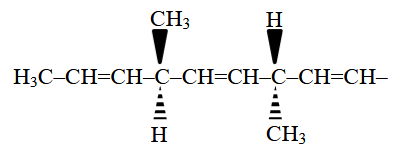
To determine the number of optically active products, we analyze the fragments produced by the complete ozonolysis of the given compound and examine each for chirality.
Complete ozonolysis cleaves all carbon-carbon double bonds $$\left(C=C\right)$$ and converts them into carbonyl groups $$\left(C=O\right).$$
The given polyene can be represented as
$$
CH_3-CH=CH-C^(CH_3)(H)-CH=CH-C^(H)(CH_3)-CH=CH-CH_3.
$$
Breaking the molecule at each of the three double bonds gives the following fragments:
Now, let us examine the optical activity of each product.
Ethanal $$\left(CH_3CHO\right)$$ does not contain any stereocentre and is therefore achiral.
For 2-methylpropanedial $$\left(OHC-CH(CH_3)-CHO\right),$$ the central carbon is attached to:
Since two of the substituents are identical $$\left(-CHO\right),$$ the central carbon is not a stereogenic centre. The molecule possesses a plane of symmetry and is therefore achiral.
Although the original reactant contains chiral centres, ozonolysis converts the neighbouring alkene fragments into identical aldehyde groups, thereby destroying the chirality of the molecule.
Hence, none of the products formed after complete ozonolysis are optically active.
Therefore, the number of optically active products is
$$
\boxed{0}.
$$
Was this solution helpful?
Create a FREE account and get:
_1.webp)

Educational materials for JEE preparation

Ask our AI anything

AI can make mistakes. Please verify important information.
AI can make mistakes. Please verify important information.
