
Join Our JEE Preparation Group
Prep with like-minded aspirants; Get access to free daily tests and study material.
Sign in
Please select an account to continue using cracku.in
↓ →
Join Our JEE Preparation Group
Prep with like-minded aspirants; Get access to free daily tests and study material.
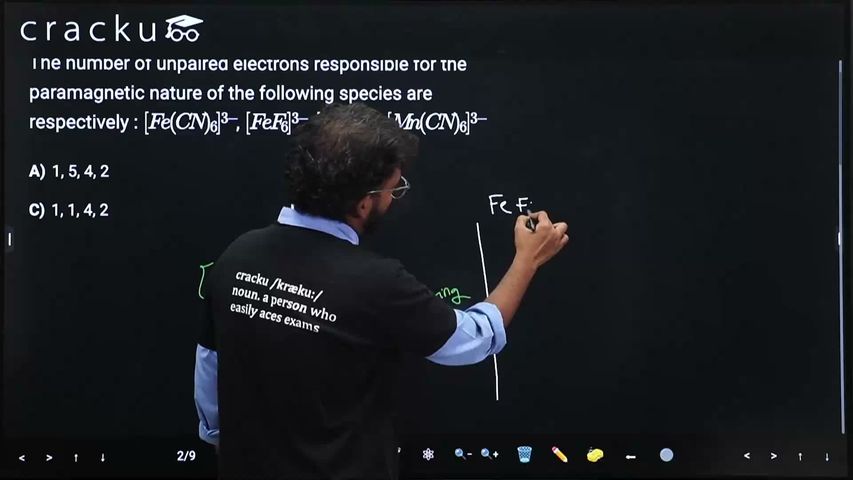
The number of unpaired electrons responsible for the paramagnetic nature of the following species are respectively : $$[Fe(CN)_6]^{3-}$$, $$[FeF_6]^{3-}$$, $$[CoF_6]^{3-}$$, $$[Mn(CN)_6]^{3-}$$
Case 1: $$[Fe(CN)_6]^{3-}$$ (octahedral)
Oxidation state of Fe:
$$x + 6(-1) = -3 \;\Rightarrow\; x = +3$$
Electronic configuration of $$Fe^{3+}$$: $$[Ar]\,3d^5$$ ($$d^5$$ system)
$$CN^-$$ is a strong-field ligand, so $$\Delta_o \gt P$$ and a low-spin arrangement occurs.
Filling the $$t_{2g}$$ and $$e_g$$ orbitals: $$t_{2g}^5\,e_g^0$$
Of the five $$t_{2g}$$ electrons, four pair up and one remains single → unpaired electrons = $$1$$.
Case 2: $$[FeF_6]^{3-}$$ (octahedral)
Oxidation state of Fe is again $$+3$$, so $$Fe^{3+}$$ has $$d^5$$.
$$F^-$$ is a weak-field ligand, therefore $$\Delta_o \lt P$$ and a high-spin complex forms.
Filling pattern: $$t_{2g}^3\,e_g^2$$
Each of the five $$d$$ electrons occupies a separate orbital → unpaired electrons = $$5$$.
Case 3: $$[CoF_6]^{3-}$$ (octahedral)
Oxidation state of Co:
$$x + 6(-1) = -3 \;\Rightarrow\; x = +3$$
Electronic configuration of $$Co^{3+}$$: $$[Ar]\,3d^6$$ ($$d^6$$ system)
With weak-field $$F^-$$ ligands (high-spin):
Filling pattern: $$t_{2g}^4\,e_g^2$$
Diagrammatically, two $$t_{2g}$$ orbitals contain one unpaired electron each and both $$e_g$$ orbitals contain one unpaired electron each. Hence unpaired electrons = $$4$$.
Case 4: $$[Mn(CN)_6]^{3-}$$ (octahedral)
Oxidation state of Mn:
$$x + 6(-1) = -3 \;\Rightarrow\; x = +3$$
Electronic configuration of $$Mn^{3+}$$: $$[Ar]\,3d^4$$ ($$d^4$$ system)
$$CN^-$$ is a strong-field ligand; the complex is low-spin:
Filling pattern: $$t_{2g}^4\,e_g^0$$
The four $$t_{2g}$$ electrons produce two paired and two unpaired electrons → unpaired electrons = $$2$$.
Therefore, the numbers of unpaired electrons are
$$[Fe(CN)_6]^{3-}: 1,\quad [FeF_6]^{3-}: 5,\quad [CoF_6]^{3-}: 4,\quad [Mn(CN)_6]^{3-}: 2$$.
This matches Option A: $$1,\,5,\,4,\,2$$.
Was this solution helpful?
Click on the Email ☝️ to Watch the Video Solution
Create a FREE account and get:
_1.webp)

Educational materials for JEE preparation

Ask our AI anything

AI can make mistakes. Please verify important information.
AI can make mistakes. Please verify important information.
