
Join Our JEE Preparation Group
Prep with like-minded aspirants; Get access to free daily tests and study material.
Sign in
Please select an account to continue using cracku.in
↓ →
Join Our JEE Preparation Group
Prep with like-minded aspirants; Get access to free daily tests and study material.
Given below are two statements :
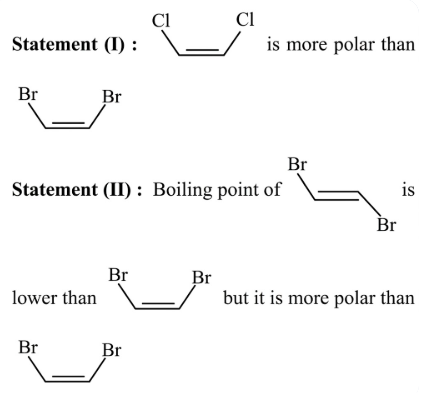
In the light of the above statements, choose the most appropriate answer from the options given below :
To determine the correct option, we need to evaluate the physical properties, specifically polarity and boiling point, of the molecules given in the two statements.
The first statement says that cis-1,2-dichloroethene is more polar than cis-1,2-dibromoethene.
The polarity of a molecule depends on its net dipole moment, which is the vector sum of all the individual bond dipoles.
Chlorine is more electronegative than bromine. Therefore, the carbon-chlorine $$\left(C-Cl\right)$$ bond has a larger bond dipole than the carbon-bromine $$\left(C-Br\right)$$ bond.
In both cis isomers, the two halogen atoms are present on the same side of the double bond. As a result, the individual bond dipoles reinforce each other instead of cancelling.
Since the $$C-Cl$$ bond dipoles are stronger than the $$C-Br$$ bond dipoles, cis-1,2-dichloroethene has a larger net dipole moment and is therefore more polar than cis-1,2-dibromoethene.
Hence, Statement (I) is correct.
The second statement says that the boiling point of trans-1,2-dibromoethene is lower than cis-1,2-dibromoethene, but it is more polar than cis-1,2-dibromoethene.
The first part of the statement is correct. The cis isomer is polar and experiences dipole-dipole interactions in addition to London dispersion forces. The trans isomer is non-polar and experiences only London dispersion forces. Therefore, the cis isomer has a higher boiling point, and the boiling point of the trans isomer is lower.
The second part of the statement is incorrect. In trans-1,2-dibromoethene, the two bromine atoms are present on opposite sides of the double bond. Their bond dipoles act in opposite directions and cancel each other completely, giving a net dipole moment $$\mu = 0$$.
Therefore, the trans isomer is non-polar, while the cis isomer is polar.
Hence, Statement (II) is incorrect.
Therefore,
The correct answer is
$$\boxed{\text{Statement I is correct but Statement II is incorrect.}}$$
Was this solution helpful?
Create a FREE account and get:
_1.webp)

Educational materials for JEE preparation

Ask our AI anything

AI can make mistakes. Please verify important information.
AI can make mistakes. Please verify important information.
