Join WhatsApp Icon JEE WhatsApp Group
Question 66

Benzyl isocyanide can be obtained from:
image

Choose the correct answer from the options given below:

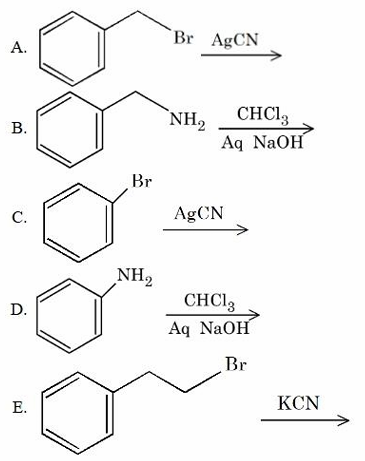
Reaction A (Correct)

  • Reactants: Benzyl bromide ($$\text{C}_6\text{H}_5\text{CH}_2\text{Br}$$) + Silver cyanide ($$\text{AgCN}$$)
  • Mechanism: Silver cyanide ($$\text{AgCN}$$) is covalent in nature. Because the $$\text{Ag-C}$$ bond is strong, the lone pair on the nitrogen atom acts as the nucleophile rather than the carbon atom. This nucleophilic substitution ($$\text{S}_\text{N}2$$) yields an isocyanide.
  • Product: Benzyl isocyanide ($$\text{C}_6\text{H}_5\text{CH}_2\text{NC}$$)

Reaction B (Correct)

  • Reactants: Benzylamine ($$\text{C}_6\text{H}_5\text{CH}_2\text{NH}_2$$) + Chloroform ($$\text{CHCl}_3$$) + aq. $$\text{NaOH}$$
  • Mechanism: This is the Carbylamine reaction (Hofmann's isocyanide test). The primary amine reacts with chloroform in a basic medium via a dichlorocarbene ($$:\text{CCl}_2$$) intermediate to form an isocyanide.
  • Product: Benzyl isocyanide ($$\text{C}_6\text{H}_5\text{CH}_2\text{NC}$$)

Reaction C (Incorrect)

  • Reactants: Bromobenzene ($$\text{C}_6\text{H}_5\text{Br}$$) + Silver cyanide ($$\text{AgCN}$$)
  • Mechanism: Bromobenzene does not easily undergo nucleophilic substitution under normal conditions due to the resonance-stabilized, partial double-bond character of the $$\text{C-Br}$$ bond. Even under drastic conditions, it would yield phenyl isocyanide ($$\text{C}_6\text{H}_5\text{NC}$$), which lacks the required $$-\text{CH}_2-$$ carbon spacer.

Reaction D (Incorrect)

  • Reactants: Aniline ($$\text{C}_6\text{H}_5\text{NH}_2$$) + Chloroform ($$\text{CHCl}_3$$) + aq. $$\text{NaOH}$$
  • Mechanism: While this also undergoes the Carbylamine reaction, the starting material is an aromatic primary amine without a side-chain carbon.
  • Product: Phenyl isocyanide ($$\text{C}_6\text{H}_5\text{NC}$$)

Reaction E (Incorrect)

  • Reactants: 2-Phenylethyl bromide ($$\text{C}_6\text{H}_5\text{CH}_2\text{CH}_2\text{Br}$$) + Potassium cyanide ($$\text{KCN}$$)
  • Mechanism: Potassium cyanide ($$\text{KCN}$$) is ionic, providing free $$\text{CN}^-$$ ions where the negatively charged carbon acts as the nucleophile. Furthermore, the starting alkyl chain already has two carbon atoms instead of one.
  • Product: 3-Phenylpropanenitrile ($$\text{C}_6\text{H}_5\text{CH}_2\text{CH}_2\text{CN}$$)

Correct Option: A and B Only

Get AI Help

Video Solution

video

Create a FREE account and get:

  • Free JEE Mains Previous Papers PDF
  • Take JEE Mains paper tests
Ask AI