
Join Our JEE Preparation Group
Prep with like-minded aspirants; Get access to free daily tests and study material.
Sign in
Please select an account to continue using cracku.in
↓ →
Join Our JEE Preparation Group
Prep with like-minded aspirants; Get access to free daily tests and study material.
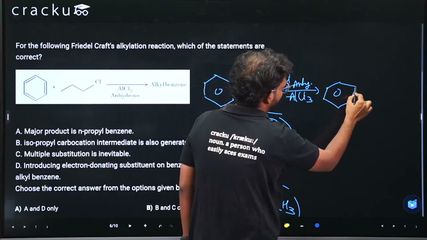
For the following Friedel Craft's alkylation reaction, which of the statements are correct?

A. Major product is n-propyl benzene.
B. iso-propyl carbocation intermediate is also generated.
C. Multiple substitution is inevitable.
D. Introducing electron-donating substituent on benzene will not produce any alkyl benzene.
Choose the correct answer from the options given below:
When 1-chloropropane reacts with anhydrous $$\text{AlCl}_3$$, it initially forms a primary carbocation ($$\text{CH}_3\text{CH}_2\text{CH}_2^+$$). This primary carbocation undergoes a 1,2-hydride shift to form a more stable secondary carbocation (the isopropyl carbocation). Because the secondary carbocation is more stable, isopropylbenzene (cumene) is formed as the major product, not n-propylbenzene.
As mentioned above, the primary carbocation rearranges via a hydride shift to generate the more stable isopropyl carbocation ($$\text{CH}_3\text{CH}^+\text{CH}_3$$) intermediate.
The alkyl group introduced onto the benzene ring is an electron-donating group (via inductive and hyperconjugation effects). This activates the benzene ring, making the product more reactive toward electrophilic substitution than the starting benzene itself. Consequently, polyalkylation (multiple substitutions) is a major drawback and is highly favored.
Electron-donating groups activate the benzene ring towards electrophilic aromatic substitution, making Friedel-Crafts alkylation happen even more readily. (It is strong electron-withdrawing groups, like $$-\text{NO}_2$$, that deactivate the ring and stop the reaction).
Correct Option: B and C only
Was this solution helpful?
Click on the Email ☝️ to Watch the Video Solution
Create a FREE account and get:
_1.webp)

Educational materials for JEE preparation

Ask our AI anything

AI can make mistakes. Please verify important information.
AI can make mistakes. Please verify important information.


