
Join Our JEE Preparation Group
Prep with like-minded aspirants; Get access to free daily tests and study material.
Sign in
Please select an account to continue using cracku.in
↓ →
Join Our JEE Preparation Group
Prep with like-minded aspirants; Get access to free daily tests and study material.
"P" is a hydrocarbon of molecular formula: $$C_8H_{14}$$. On ozonolysis, "P" forms "Q". "Q" on treatment with alkali under reflux condition produces "R", which on treatment with $$I_2$$/NaOH gives a yellow precipitate. Acidification of the solution gives "S". The structure of "S" is given below:-
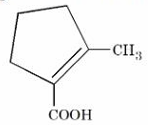
The correct structure of "P" is
Compound $$R$$ gives a yellow precipitate with $$\mathrm{I_2/NaOH}$$ and on acidification forms compound $$S$$. This is the iodoform reaction, which is given by methyl ketones.
Since compound $$S$$ contains a carboxylic acid group attached to the cyclopentene ring, compound $$R$$ must contain a methyl ketone group at the same position.
Hence, $$R$$ is 1-acetyl-2-methylcyclopentene.
Compound $$Q$$ on treatment with alkali under reflux gives $$R$$, indicating an intramolecular aldol condensation.
Retrosynthetic cleavage of the newly formed $$\mathrm{C=C}$$ bond in $$R$$ gives the open-chain diketone
$$\mathrm{CH_3COCH_2CH_2CH_2CH_2COCH_3}$$
Thus, $$Q$$ is 2,7-octanedione.
Compound $$P\ (C_8H_{14})$$ undergoes ozonolysis to give $$Q$$. Reversing ozonolysis, the two carbonyl carbons of 2,7-octanedione are joined by a double bond.
Joining C-2 and C-7 forms a cyclohexene ring having methyl groups on both double-bonded carbons.
Therefore, compound $$P$$ is 1,2-dimethylcyclohexene.
Hence, the correct option is (D).
Was this solution helpful?
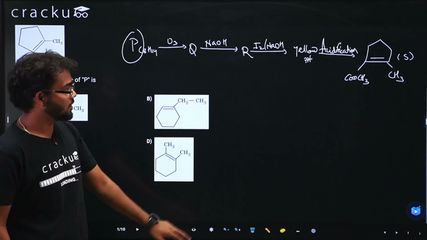
Click on the Email ☝️ to Watch the Video Solution
Create a FREE account and get:
_1.webp)

Educational materials for JEE preparation

Ask our AI anything

AI can make mistakes. Please verify important information.
AI can make mistakes. Please verify important information.


