
Join Our JEE Preparation Group
Prep with like-minded aspirants; Get access to free daily tests and study material.
Sign in
Please select an account to continue using cracku.in
↓ →
Join Our JEE Preparation Group
Prep with like-minded aspirants; Get access to free daily tests and study material.
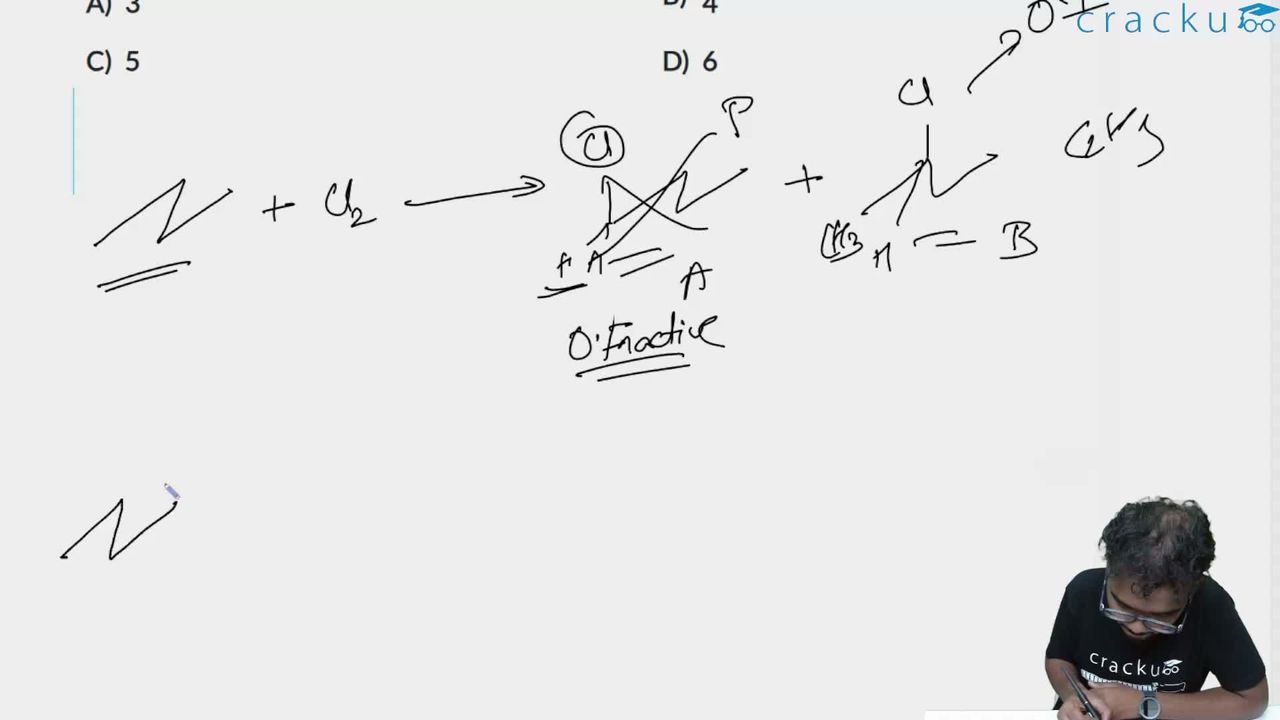
n-Butane on monochlorination under photochemical condition gives an optically active compound "P". "P" on further chlorination gives dichloro compounds. The number of dichloro compounds obtained (ignore stereoisomers) is :
Step 1: Identify Compound "P"
$$n$$-Butane has the structure: $$\text{CH}_3-\text{CH}_2-\text{CH}_2-\text{CH}_3$$.
When it undergoes monochlorination ($$\text{Cl}_2 / h\nu$$), it can form two structural isomers:
Since the problem states that compound "P" is optically active, "P" must be 2-chlorobutane.
Step 2: Further Chlorination of "P"
Now, we add a second chlorine atom to 2-chlorobutane at every possible carbon position to find all the unique structural (constitutional) dichloro compounds.
Let's number the chain: $$\overset{1}{\text{C}}\text{H}_3 - \overset{2}{\text{C}}\text{H(Cl)} - \overset{3}{\text{C}}\text{H}_2 - \overset{4}{\text{C}}\text{H}_3$$
$$\text{CH}_2\text{Cl}-\text{CH(Cl)}-\text{CH}_2-\text{CH}_3 \rightarrow \textbf{1,2-dichlorobutane}$$
$$\text{CH}_3-\text{C(Cl)}_2-\text{CH}_2-\text{CH}_3 \rightarrow \textbf{2,2-dichlorobutane}$$
$$\text{CH}_3-\text{CH(Cl)}-\text{CH(Cl)}-\text{CH}_3 \rightarrow \textbf{2,3-dichlorobutane}$$
$$\text{CH}_3-\text{CH(Cl)}-\text{CH}_2-\text{CH}_2\text{Cl} \rightarrow \textbf{1,3-dichlorobutane}$$
Ignoring stereoisomers, we get exactly 4 unique structural dichloro compounds:
Therefore, the correct option is B (4).
Was this solution helpful?
Click on the Email ☝️ to Watch the Video Solution
Create a FREE account and get:
_1.webp)

Educational materials for JEE preparation

Ask our AI anything

AI can make mistakes. Please verify important information.
AI can make mistakes. Please verify important information.
