
Join Our JEE Preparation Group
Prep with like-minded aspirants; Get access to free daily tests and study material.
Sign in
Please select an account to continue using cracku.in
↓ →
Join Our JEE Preparation Group
Prep with like-minded aspirants; Get access to free daily tests and study material.
Given below are two statements :
Statement I : Due to increase in van der Waals forces, the order of boiling points is CH$$_3$$CH$$_2$$CH$$_2$$I > CH$$_3$$CH$$_2$$I > CH$$_3$$I.
Statement II : As
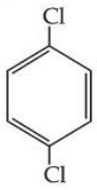
is more symmetric, its melting point is higher than
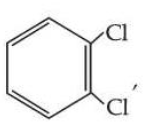
, however its boiling point is lower than
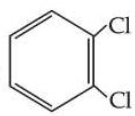
.
In the light of the above statements, choose the correct answer from the options given below :
Statement I:
The boiling point of alkyl halides increases with an increase in molecular mass and size because the magnitude of van der Waals forces directly depends on the surface area and the total number of electrons in the molecule.
1-Iodopropane ($$\text{CH}_3\text{CH}_2\text{CH}_2\text{I}$$) has a larger surface area than iodoethane ($$\text{CH}_3\text{CH}_2\text{I}$$), which in turn has a larger surface area than iodomethane ($$\text{CH}_3\text{I}$$).
Thus, Statement I is true.
Statement II:
para-Dichlorobenzene is highly symmetrical compared to its ortho and meta isomers. Due to this symmetry, it fits exceptionally well into the crystal lattice structure, resulting in a significantly higher melting point.
The ortho isomer has a higher dipole moment ($$\mu$$) compared to the para isomer (where the opposing C-Cl dipoles cancel out, making $$\mu = 0$$). Higher polarity leads to stronger intermolecular dipole-dipole attractions in the liquid phase, giving the ortho isomer a higher boiling point than the para isomer
Thus, Statement II is true.
[A] Both Statement I and Statement II are true
Was this solution helpful?
Click on the Email ☝️ to Watch the Video Solution
Create a FREE account and get:
_1.webp)

Educational materials for JEE preparation

Ask our AI anything

AI can make mistakes. Please verify important information.
AI can make mistakes. Please verify important information.
