
Join Our JEE Preparation Group
Prep with like-minded aspirants; Get access to free daily tests and study material.
Sign in
Please select an account to continue using cracku.in
↓ →
Join Our JEE Preparation Group
Prep with like-minded aspirants; Get access to free daily tests and study material.
Chlorination of an aromatic compound can follow two different pathways, depending on the reaction conditions:
1. Radical (side-chain) chlorination: $$Cl_2$$ in the presence of heat, light, or peroxides produces benzyl chloride, benzal chloride, etc.
2. Electrophilic (ring) chlorination: $$Cl_2$$ in the presence of a Lewis-acid catalyst such as $$FeCl_3$$ produces chlorinated aromatic rings.
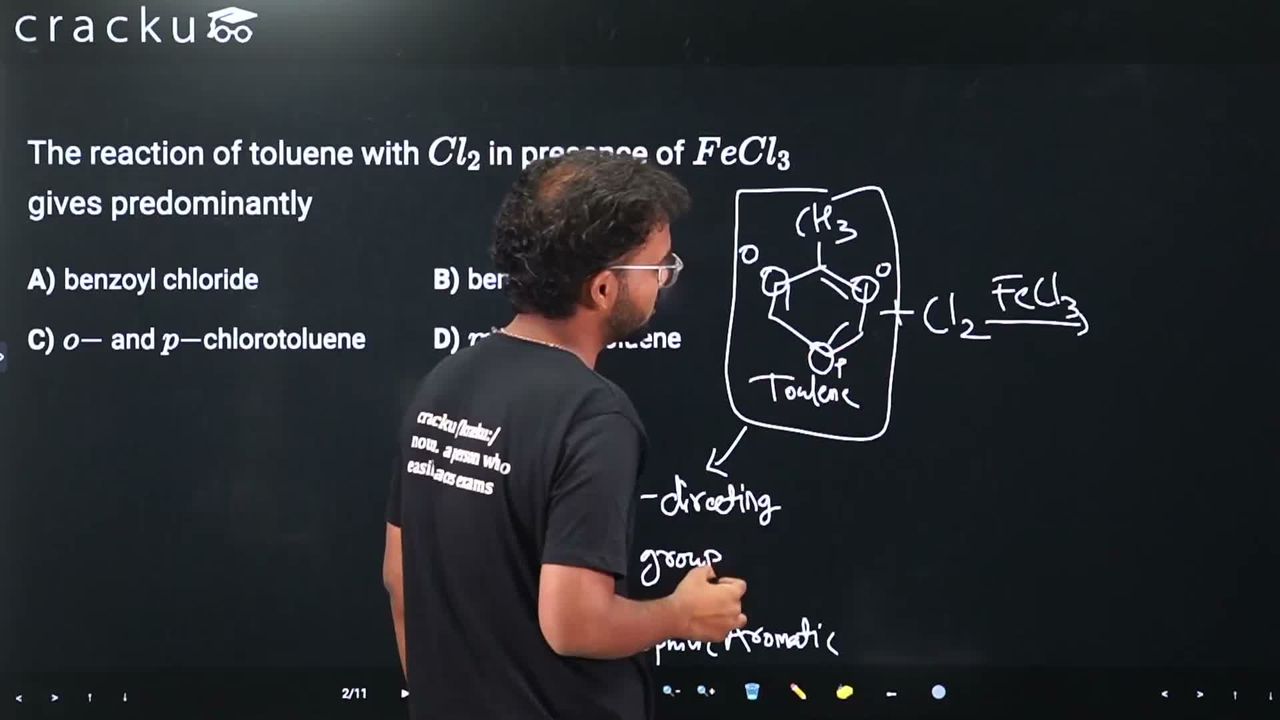
In this question the reagent system is $$Cl_2/FeCl_3$$, so the reaction proceeds through the electrophilic aromatic substitution (EAS) mechanism.
The methyl group in toluene is:
• Electron-donating through hyperconjugation and +I effect.
• Activating and ortho/para-directing in EAS.
Therefore the incoming electrophile $$Cl^+$$ attacks predominantly at the ortho and para positions of the benzene ring relative to the $$CH_3$$ group.
Hence the major products are $$o$$-chlorotoluene and $$p$$-chlorotoluene.
Option C which is: $$o-$$ and $$p-$$chlorotoluene
Was this solution helpful?
Click on the Email ☝️ to Watch the Video Solution
Create a FREE account and get:
_1.webp)

Educational materials for JEE preparation

Ask our AI anything

AI can make mistakes. Please verify important information.
AI can make mistakes. Please verify important information.
