
Join Our JEE Preparation Group
Prep with like-minded aspirants; Get access to free daily tests and study material.
Sign in
Please select an account to continue using cracku.in
↓ →
Join Our JEE Preparation Group
Prep with like-minded aspirants; Get access to free daily tests and study material.
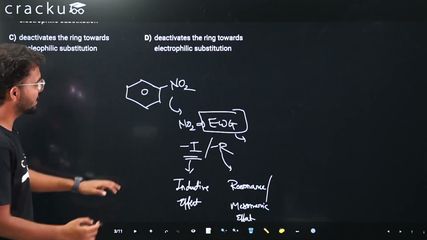
The nitro group is represented as $$-NO_2$$. Its electronic behaviour can be understood through two effects:
1. Strong $$-I$$ effect (inductive withdrawal): The electronegative oxygen atoms pull electron density away from the ring through the σ-bond framework.
2. Strong $$-R$$ effect (resonance withdrawal): One of the oxygen atoms can withdraw the π-electron pair from the ring, forming a resonance structure like
$$\text{Benzene-NO}_2 \longrightarrow \text{O=N}^+\text{-O}^- \xrightarrow{\text{Resonance}} \text{O}^-\text{-N}^+=\text{O (with positive charge in the ring)}$$
The resonance structures place a partial positive charge on the ortho and para carbon atoms of the ring. Thus electron density throughout the ring decreases. Because electrophilic substitution reactions require electron-rich aromatic rings to attract an incoming electrophile $$E^{+}$$, any factor that removes electron density deactivates the ring toward electrophilic attack.
Let us check each option:
Option A Activates the ring toward electrophilic substitution - Incorrect; the nitro group withdraws electrons, so it has the opposite effect.
Option B Renders the ring basic - Incorrect; lower electron density actually makes the ring less basic.
Option C Deactivates the ring toward nucleophilic substitution - Incorrect; an electron-withdrawing group like $$-NO_2$$ actually activates the ring toward nucleophilic aromatic substitution (by stabilising the Meisenheimer complex).
Option D Deactivates the ring toward electrophilic substitution - Correct; explained above.
Hence, the right choice is:
Option D which is: deactivates the ring towards electrophilic substitution.
Was this solution helpful?
Click on the Email ☝️ to Watch the Video Solution
Create a FREE account and get:
_1.webp)

Educational materials for JEE preparation

Ask our AI anything

AI can make mistakes. Please verify important information.
AI can make mistakes. Please verify important information.
