Join Our JEE Preparation Group
Prep with like-minded aspirants; Get access to free daily tests and study material.
Sign in
Please select an account to continue using cracku.in
↓ →
Join Our JEE Preparation Group
Prep with like-minded aspirants; Get access to free daily tests and study material.
Step 1: Locate the longest continuous carbon chain
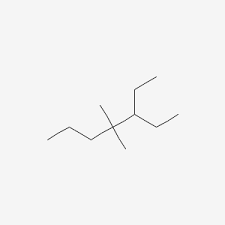
Starting from any carbon atom and moving through the skeleton one finds a chain of $$7$$ carbon atoms. Hence the parent (root) hydrocarbon is $$\text{heptane}$$.
Step 2: Identify and list the substituents
On this seven-carbon backbone there are
• one ethyl group $$\left(-CH_2CH_3\right)$$, and
• two methyl groups $$\left(-CH_3\right)$$ attached to the same carbon.
Step 3: Number the parent chain to obtain the lowest set of locants
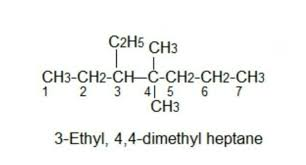
Numbering from the left end of the drawn chain gives substituent positions $$3$$ (ethyl) and $$4,4$$ (methyls).
Numbering from the opposite end would give positions $$5$$ (ethyl) and $$4,4$$ (methyls), i.e. the locant set $$5,4,4$$. Because $$3,4,4$$ is lexicographically smaller than $$5,4,4$$, the correct numbering is left-to-right.
Step 4: Assemble the IUPAC name
List the substituents in alphabetical order, each preceded by its locant(s) and multiplicative prefix if needed:
• ethyl > methyl in alphabetical ordering.
Hence the final name is
$$3\text{-ethyl-}4,4\text{-dimethylheptane}$$.
Step 5: Check the given options
Option D matches the derived name, whereas Options A, B and C are based on choosing a five-carbon parent chain (pentane) which is shorter than the permissible seven-carbon chain and therefore violate the IUPAC rule that the principal chain must be the longest possible.
Therefore, the correct answer is:
Option D which is: $$3$$-ethyl-$$4,4$$-dimethylheptane.
Was this solution helpful?
Create a FREE account and get:
_1.webp)

Educational materials for JEE preparation

Ask our AI anything

AI can make mistakes. Please verify important information.
AI can make mistakes. Please verify important information.