
Join Our JEE Preparation Group
Prep with like-minded aspirants; Get access to free daily tests and study material.
Sign in
Please select an account to continue using cracku.in
↓ →
Join Our JEE Preparation Group
Prep with like-minded aspirants; Get access to free daily tests and study material.
Given below are two statements :
Statement I : In
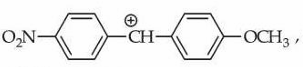
the carbocation is stabilised by +R effect of $$-OCH_3$$ group.
Statement II : In
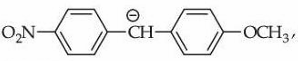
the carbanion is stabilised by $$-R$$ effect of $$-NO_2$$ group.
To evaluate the validity of the given statements, we analyze the electronic effects exerted by the substituent groups on the corresponding reactive intermediates.
The first statement states that the carbocation is stabilized by the $$+R$$ effect of the $$-OCH_3$$ group. A carbocation is an electron-deficient species and is stabilized by substituents capable of donating electron density. The methoxy group contains a lone pair of electrons on the oxygen atom, which can participate in resonance with the aromatic ring. Through this $$+R$$ (or $$+M$$) effect, electron density is delocalized toward the positively charged center, thereby stabilizing the carbocation. Hence, Statement I is true.
The second statement claims that the carbanion is stabilized by the $$-R$$ effect of the $$-NO_2$$ group. A carbanion carries excess electron density and is stabilized by electron-withdrawing substituents. The nitro group is a strong electron-withdrawing group that exhibits both $$-I$$ and $$-R$$ effects. Through its $$-R$$ effect, it withdraws electron density from the aromatic system and delocalizes the negative charge by resonance, thereby stabilizing the carbanion. Hence, Statement II is also true.
Therefore, both the resonance-donating $$+R$$ effect of the methoxy group stabilizing a carbocation and the resonance-withdrawing $$-R$$ effect of the nitro group stabilizing a carbanion are valid principles of organic chemistry.
Correct Answer: Both Statement I and Statement II are true.
Was this solution helpful?
Click on the Email ☝️ to Watch the Video Solution
Create a FREE account and get:
_1.webp)

Educational materials for JEE preparation

Ask our AI anything

AI can make mistakes. Please verify important information.
AI can make mistakes. Please verify important information.
