
Join Our JEE Preparation Group
Prep with like-minded aspirants; Get access to free daily tests and study material.
Sign in
Please select an account to continue using cracku.in
↓ →
Join Our JEE Preparation Group
Prep with like-minded aspirants; Get access to free daily tests and study material.
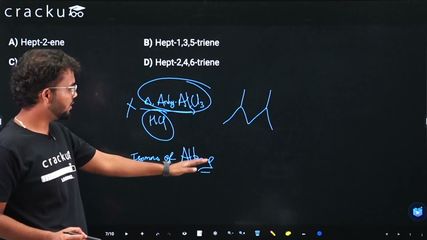
The compound (X) on
(i) on heating in the presence of anhydrous AlCl$$_3$$ and HCl gas gives 2,4-dimethyl pentane
(ii) aromatization gives toluene and
(iii) cyclisation gives methyl cyclohexane
The correct name of compound (X) is :
First, note that all three reactions mentioned in the statement — isomerisation with $$\text{anh.}\,AlCl_3/HCl$$, aromatisation and cyclisation — are characteristic transformations shown by straight-chain alkanes when treated with suitable catalysts at elevated temperature.
Let the unknown hydrocarbon be $$\mathrm{C_7H_{14}}$$ (an alkene or triene) or $$\mathrm{C_7H_{16}}$$ (an alkane).
We now match the products obtained in each step with the known behaviour of C-7 hydrocarbons.
Step (1) Isomerisation:
Straight-chain alkanes in the presence of $$\text{anh.}\,AlCl_3$$ and dry $$HCl$$ undergo skeletal rearrangement to give more highly branched isomers having the same molecular formula.
For the product to be $$2,4\text{-dimethylpentane}$$ (molecular formula $$\mathrm{C_7H_{16}}$$), the starting compound must also possess the same formula $$\mathrm{C_7H_{16}}$$. The only option given that matches this requirement is heptane (the straight-chain isomer).
Step (2) Aromatisation:
A normal C-7 alkane on dehydrogenation and ring-closure over a Pt/Cr2O3 catalyst forms a C-6 aromatic ring plus one carbon as a side chain, i.e.
$$\mathrm{C_6H_5CH_3}$$ (toluene) $$+$$ $$4H_2$$.
This is exactly the product stated, confirming that the substrate is the normal (unbranched) C-7 alkane.
Step (3) Cyclisation:
Normal alkanes containing 6-10 carbons cyclise over acidic catalysts (e.g.\ alumina) to give n-1 membered cycloalkanes carrying one alkyl substituent. Thus an n-heptane chain folds to give $$\mathrm{CH_3-(CH_2)_5-CH_3} \longrightarrow \mathrm{CH_3-C_6H_{11}}$$ which is methyl cyclohexane, the product mentioned.
All three observations are therefore satisfied only by the straight-chain alkane $$\mathbf{n\text{-}heptane}$$.
Hence, the correct name of compound (X) is Heptane.
Option C $$\longrightarrow\ $$Heptane
Was this solution helpful?
Click on the Email ☝️ to Watch the Video Solution
Create a FREE account and get:
_1.webp)

Educational materials for JEE preparation

Ask our AI anything

AI can make mistakes. Please verify important information.
AI can make mistakes. Please verify important information.
