
Join Our JEE Preparation Group
Prep with like-minded aspirants; Get access to free daily tests and study material.
Sign in
Please select an account to continue using cracku.in
↓ →
Join Our JEE Preparation Group
Prep with like-minded aspirants; Get access to free daily tests and study material.
Correct statements regarding alkyl halides $$(R-X)$$ among the following are :
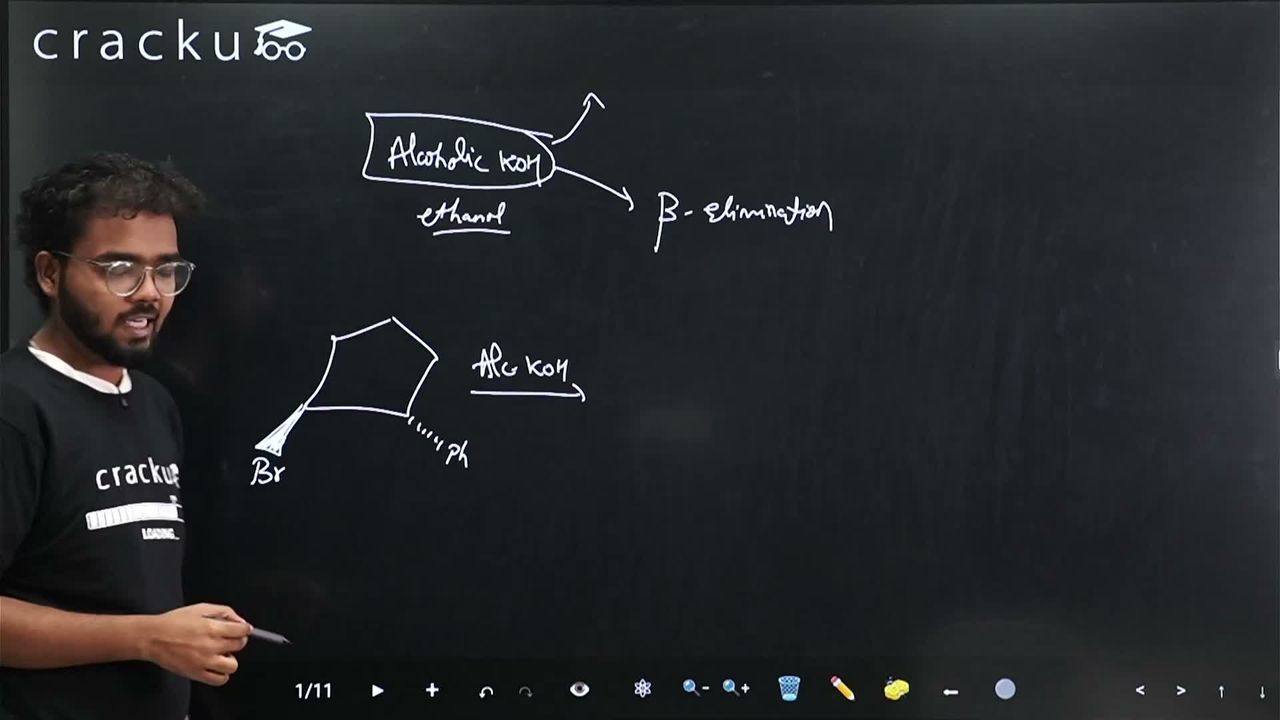
A. Alcohol being less polar solvent favours elimination with alcoholic KOH favours elimination reaction with $$R - X.$$
B. Order of reactivity towards $$S_N1$$ is $$C_6H_5-CH_2-Cl > C_6H_5-CHCl-C_6H_5$$.
C. Non substituted aryl halides exhibit properties similar to alkyl halides.
D. Vinyl chloride is example of haloalkene and allyl chloride is example of haloalkyne.
E. $$R-Cl$$ can be prepared by reacting $$R-OH$$ with $$SOCl_2$$ but $$Ar-Cl$$ cannot be prepared by reacting $$Ar-OH$$ with $$SOCl_2$$.
Choose the correct answer from the options given below :
The question asks us to test each statement (A - E) about halogen-substituted compounds and then pick the option that contains all and only the correct ones.
Statement A
“Alcohol being less polar solvent favours elimination with alcoholic KOH.”
• In aqueous KOH, the medium is highly polar; the hydroxide ion is strongly solvated and favours nucleophilic substitution (mainly $$S_N2$$).
• In alcoholic KOH, the solvent (ethanol, propanol etc.) is less polar, the hydroxide ion is less solvated, and a strong base character dominates. This promotes $$\beta$$-elimination ($$E_2$$) giving an alkene.
Therefore Statement A is correct.
Statement B
“Order of reactivity towards $$S_N1$$ is $$C_6H_5CH_2Cl \gt C_6H_5CHClC_6H_5$$.”
• $$S_N1$$ reactions proceed through a carbocation.
• For $$C_6H_5CH_2^+$$ (benzyl carbocation) resonance with one phenyl ring stabilises the cation.
• For $$C_6H_5CH^+C_6H_5$$ (benzhydryl carbocation) two phenyl rings provide resonance stabilisation. More resonance structures → greater stability → faster $$S_N1$$.
Hence $$C_6H_5CHClC_6H_5$$ reacts faster than $$C_6H_5CH_2Cl$$, the reverse of what the statement claims. Statement B is wrong.
Statement C
“Non substituted aryl halides exhibit properties similar to alkyl halides.”
• In aryl halides, the lone pair on halogen interacts with the aromatic ring, giving a partial $$C-X$$ double-bond character. Bond dissociation energy is high and the carbon is $$sp^2$$-hybridised.
• Consequently, aryl halides are far less reactive in both $$S_N1$$ and $$S_N2$$ than alkyl halides.
Hence their chemical behaviour is quite different, so Statement C is wrong.
Statement D
“Vinyl chloride is example of haloalkene and allyl chloride is example of haloalkyne.”
• Vinyl chloride: $$CH_2=CHCl$$ — yes, a haloalkene.
• Allyl chloride: $$CH_2=CHCH_2Cl$$ — also a haloalkene (the halogen is on the carbon next to a C=C). It is not an alkyne derivative.
Therefore Statement D is wrong.
Statement E
“$$R-Cl$$ can be prepared by reacting $$R-OH$$ with $$SOCl_2$$ but $$Ar-Cl$$ cannot be prepared by reacting $$Ar-OH$$ with $$SOCl_2$$.”
• Aliphatic alcohols readily convert to alkyl chlorides with thionyl chloride: $$R-OH + SOCl_2 \rightarrow R-Cl + SO_2 + HCl$$.
• Phenols do not undergo this reaction because the $$C-O$$ bond in $$Ar-OH$$ has partial double-bond character ($$sp^2$$ carbon and resonance), making direct replacement of $$-OH$$ by $$-Cl$$ extremely difficult.
Thus Statement E is correct.
Summary
Correct: A and E.
Incorrect: B, C, D.
The option containing only A and E is Option C.
Hence, the answer is:
Option C which is: A and E Only.
Was this solution helpful?
Click on the Email ☝️ to Watch the Video Solution
Create a FREE account and get:
_1.webp)

Educational materials for JEE preparation

Ask our AI anything

AI can make mistakes. Please verify important information.
AI can make mistakes. Please verify important information.
