
Join Our JEE Preparation Group
Prep with like-minded aspirants; Get access to free daily tests and study material.
Sign in
Please select an account to continue using cracku.in
↓ →
Join Our JEE Preparation Group
Prep with like-minded aspirants; Get access to free daily tests and study material.
An organic compound "x" where molar ratio of C, O and H are equal, on treatment with 50% KOH under reflux followed by acidification produced "y". The most likely structure of "y" is :
[Molar mass of 'x' is 58 g mol$$^{-1}$$]
Step 1:
Let the molar ratios of the elements in compound $$x$$ be equal.
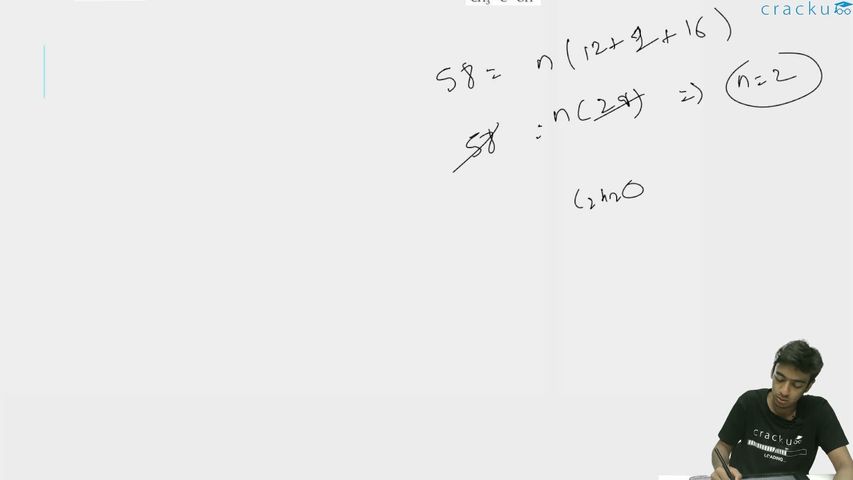
So its empirical formula is $$C_nH_nO_n$$.
Molar mass calculation:
Atomic masses: C = 12, H = 1, O = 16.
Molar mass of $$C_nH_nO_n = 12n + 1n + 16n = 29n$$.
Given molar mass of $$x$$ is 58 g mol$$^{-1}$$,
Therefore,
$$29n = 58 \;\Longrightarrow\; n = 2$$.
Hence the molecular formula of $$x$$ is $$C_2H_2O_2$$.
Step 2:
Saturation check (index of hydrogen deficiency):
For two carbons the saturated formula would be $$C_2H_{2\times2+2}=C_2H_6$$.
Degrees of unsaturation $$=\dfrac{(2C+2-H)}{2}=\dfrac{(4+2-2)}{2}=2$$.
Two degrees of unsaturation can be satisfied by two carbonyl groups, giving the structure $$OHC{-}CHO$$ (glyoxal). Glyoxal has no $$\alpha$$-hydrogen, so it undergoes Cannizzaro reaction.
Reaction in 50 % KOH, reflux:
Two molecules of glyoxal disproportionate (Cannizzaro reaction): one carbonyl group is reduced to an alcohol and the other is oxidised to a carboxylate within the same carbon skeleton, giving potassium glycolate $$HO{-}CH_2{-}COOK$$.
Subsequent acidification converts the salt to its free acid:
$$HO{-}CH_2{-}COOK + HCl \longrightarrow HO{-}CH_2{-}COOH + KCl$$.
Thus product $$y$$ is glycolic acid, $$HO{-}CH_2{-}COOH$$.
Option C $$\longrightarrow\ $$ $$O = C(OH){-}CH_2{-}OH$$ (glycolic acid)
Click on the Email ☝️ to Watch the Video Solution
Create a FREE account and get:
_1.webp)

Educational materials for JEE preparation

Ask our AI anything

AI can make mistakes. Please verify important information.
AI can make mistakes. Please verify important information.


