
Join Our JEE Preparation Group
Prep with like-minded aspirants; Get access to free daily tests and study material.
Sign in
Please select an account to continue using cracku.in
↓ →
Join Our JEE Preparation Group
Prep with like-minded aspirants; Get access to free daily tests and study material.
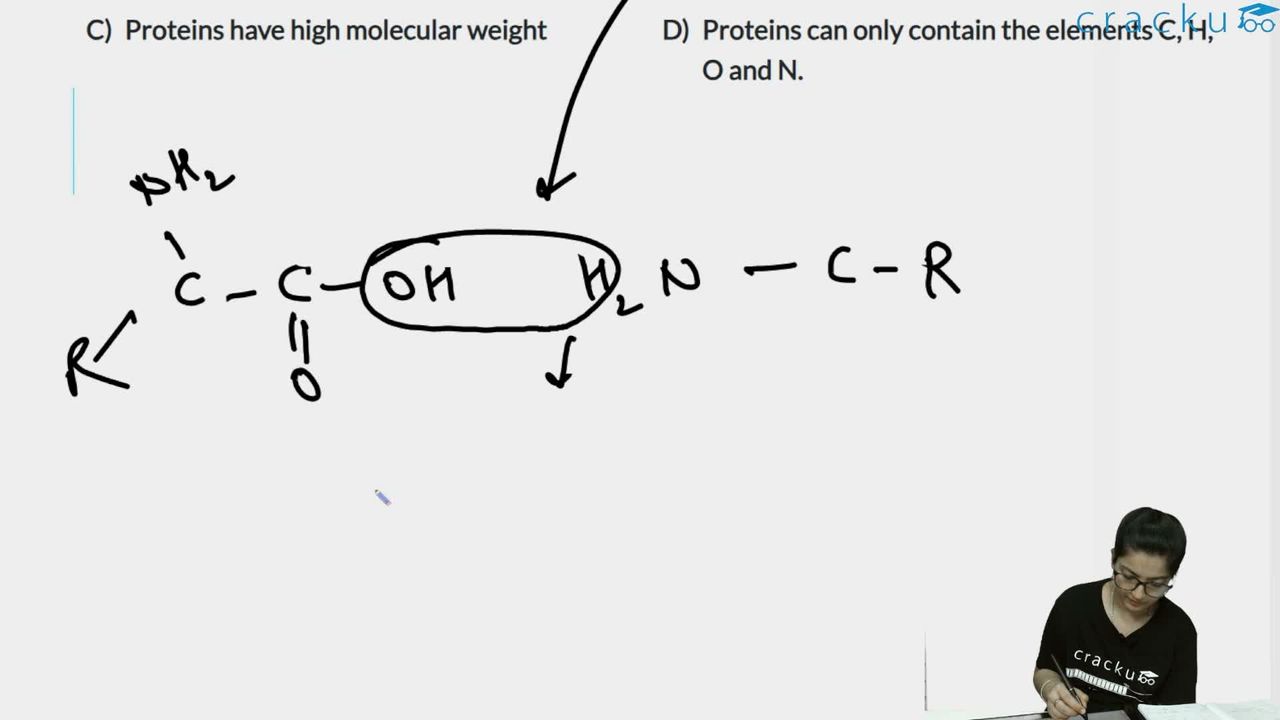
Proteins are naturally occurring biopolymers made by linking many α-amino acids through peptide (amide) bonds to give long polypeptide chains that fold into specific three-dimensional shapes.
Checking each statement:
Statement A: “Proteins generally have no definite melting point.”
When heated, proteins do not pass through a sharp melting transition; instead they undergo denaturation (loss of secondary/tertiary structure) and then slow decomposition. Hence this statement is true for proteins.
Statement B: “Proteins contain the grouping -CONH-.”
Every peptide linkage formed between two amino acids is an amide group $$-CO-NH-$$, so this functional group is present throughout the backbone of every protein. Therefore the statement is true.
Statement C: “Proteins have high molecular weight.”
Typical proteins consist of 50 - several thousand amino-acid residues, giving molar masses from $$\sim5\times10^{3}$$ to $$\gt10^{6}\,\text{g mol}^{-1}$$. Thus they are indeed high-molecular-weight macromolecules. The statement is true.
Statement D: “Proteins can only contain the elements C, H, O and N.”
Besides carbon, hydrogen, oxygen and nitrogen, many proteins also contain other elements:
• Sulfur in cysteine and methionine residues.
• Phosphorus in phosphoproteins (e.g., casein).
• Metal ions such as Fe, Cu, Zn, Mg, Mo in metalloproteins and enzymes.
Hence proteins are not limited to just C, H, O, N. This statement is false.
Because the question asks for the statement that does not apply to proteins, the correct choice is:
Option D which is: Proteins can only contain the elements C, H, O and N.
Was this solution helpful?
Click on the Email ☝️ to Watch the Video Solution
Create a FREE account and get:
_1.webp)

Educational materials for JEE preparation

Ask our AI anything

AI can make mistakes. Please verify important information.
AI can make mistakes. Please verify important information.


