
Join Our JEE Preparation Group
Prep with like-minded aspirants; Get access to free daily tests and study material.
Sign in
Please select an account to continue using cracku.in
↓ →
Join Our JEE Preparation Group
Prep with like-minded aspirants; Get access to free daily tests and study material.
The value of $$k$$ for which the equation $$(K-2)x^2 + 8x + K + 4 = 0$$ has both roots real, distinct and negative can be:
The quadratic is$$(k-2)x^{2}+8x+(k+4)=0\qquad -(1)$$with$$a=k-2,\;b=8,\;c=k+4.$$To have two real, distinct and negative roots we need three conditions:
1. Real and distinct roots ⟹ Discriminant $$D$$ positive.
2. Both roots negative ⟹ (i) their sum $$r_{1}+r_{2}$$ is negative, (ii) their product $$r_{1}r_{2}$$ is positive.
Step 1 : Discriminant > 0
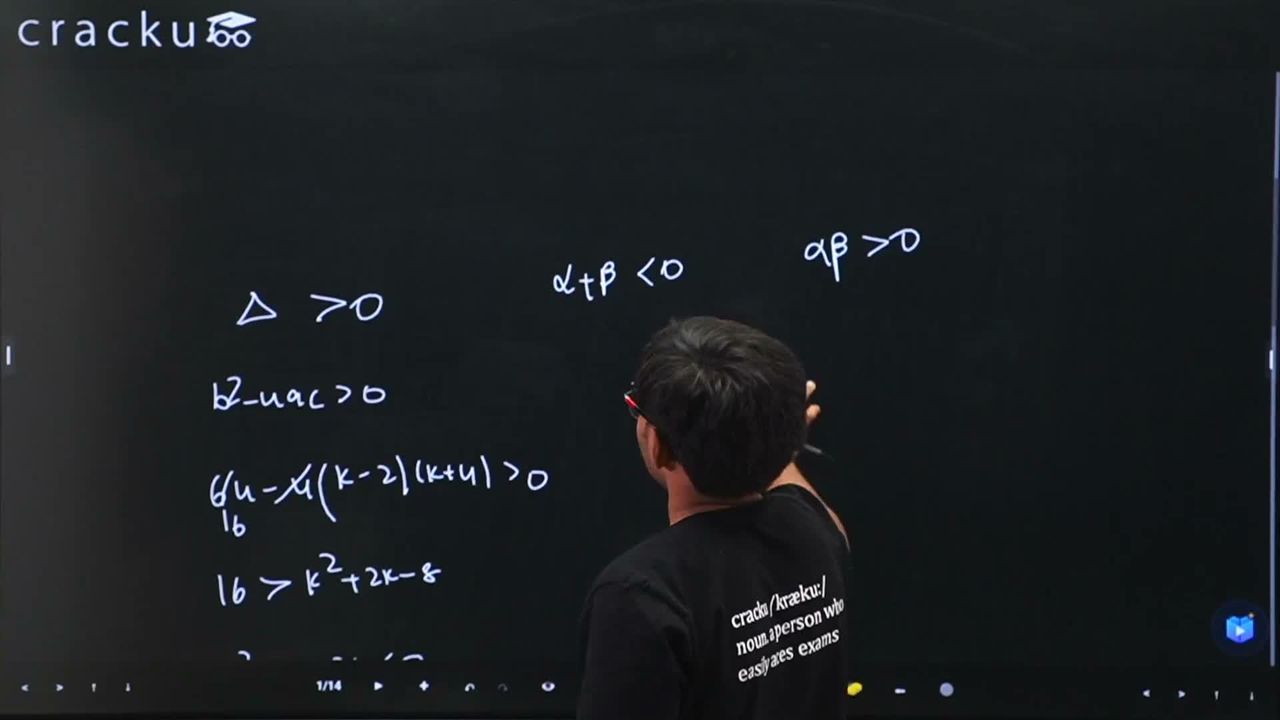
$$D=b^{2}-4ac=64-4(k-2)(k+4).$$
Compute$$(k-2)(k+4)=k^{2}+2k-8,$$so
$$D=64-4(k^{2}+2k-8)=96-4k^{2}-8k=-4(k^{2}+2k-24).$$
For $$D\gt0$$ we need$$k^{2}+2k-24\lt0.$$(This is a parabola opening upward.)
Its roots are obtained from $$k^{2}+2k-24=0,$$ giving $$k=\frac{-2\pm10}{2}=\{\,4,\,-6\}.$$
Hence$$k^{2}+2k-24\lt0\; \Longrightarrow\; -6\lt k\lt4.\qquad -(2)$$
Step 2 : Sum of roots negative
For quadratic$$(1),$$ $$r_{1}+r_{2}=-\frac{b}{a}=-\frac{8}{k-2}.$$
We require $$r_{1}+r_{2}\lt0\; \Longrightarrow\; -\frac{8}{k-2}\lt0.$$
Because $$-8\lt0,$$ the fraction is negative only if denominator $$k-2\gt0,$$ i.e.$$k\gt2.\qquad -(3)$$
Step 3 : Product of roots positive
$$r_{1}r_{2}=\frac{c}{a}=\frac{k+4}{\,k-2\,}.$$
For $$r_{1}r_{2}\gt0,$$ numerator and denominator must have the same sign.
If $$k\gt2$$ (from step 2) then $$k-2\gt0,$$ and also $$k+4\gt0,$$ so the product is indeed positive. Thus condition 3 adds no extra restriction beyond $$k\gt2.$$
Combine the inequalities
From$$(2)\; -6\lt k\lt4$$ and$$(3)\; k\gt2,$$ we obtain the admissible interval$$2\lt k\lt4.$$
Among the given options, the only value lying in this interval is $$k=3.$$
Option B which is: 3
Was this solution helpful?
Click on the Email ☝️ to Watch the Video Solution
Create a FREE account and get:
_1.webp)

Educational materials for JEE preparation

Ask our AI anything

AI can make mistakes. Please verify important information.
AI can make mistakes. Please verify important information.


