Sign in
Please select an account to continue using cracku.in
↓ →
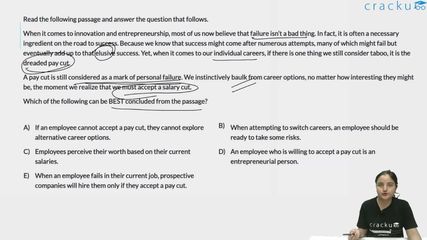
Read the following passage and answer the question that follows.
When it comes to innovation and entrepreneurship, most of us now believe that failure isn’t a bad thing. In fact, it is often a necessary ingredient on the road to success. Because we know that success might come after numerous attempts, many of which might fail but eventually add up to that elusive success. Yet, when it comes to our individual careers, if there is one thing we still consider taboo, it is the dreaded pay cut.
A pay cut is still considered as a mark of personal failure. We instinctively baulk from career options, no matter how interesting they might be, the moment we realize that we must accept a salary cut.
Which of the following can be BEST concluded from the passage?
The passage describes how people instinctively reject career options the moment a pay cut is involved, treating it as a "mark of personal failure." This reveals the underlying psychology: employees equate their salary with their personal value.
If a lower salary = failure, then logically, people see their current salary as a benchmark of their self-worth, which is exactly what C concludes. Option A is too absolute ("cannot" is too strong — the passage says they baulk, not that it's impossible).
Option B is a general advice statement about risk-taking that the passage never prescribes.
Option D makes an unsupported leap connecting pay cut acceptance to entrepreneurial personality.
Option E introduces a hiring scenario involving failure that the passage never discusses.
C is the best conclusion because it captures the root cause of why pay cuts feel taboo — it's not just about money, it's about identity and perceived self-worth.
Was this solution helpful?
Click on the Email ☝️ to Watch the Video Solution
Create a FREE account and get:
Book Free CAT Mentorship
Get personalized CAT strategy from a 99%iler
500+ students mentored
OTP Verification
Enter the 6-digit code sent to your phone
Booking Summary
Enter OTP
Didn't receive the OTP?
Start your IIM journey with the right preparation and crack CAT 2026.

Educational materials for CAT preparation

Ask our AI anything

AI can make mistakes. Please verify important information.
AI can make mistakes. Please verify important information.
 91- 6303239042