
Join Our JEE Preparation Group
Prep with like-minded aspirants; Get access to free daily tests and study material.
Sign in
Please select an account to continue using cracku.in
↓ →
Join Our JEE Preparation Group
Prep with like-minded aspirants; Get access to free daily tests and study material.
Phenol is heated with a solution of mixture of $$\text{KBr}$$ and $$\text{KBrO}_3$$. The major product obtained in the above reaction is:
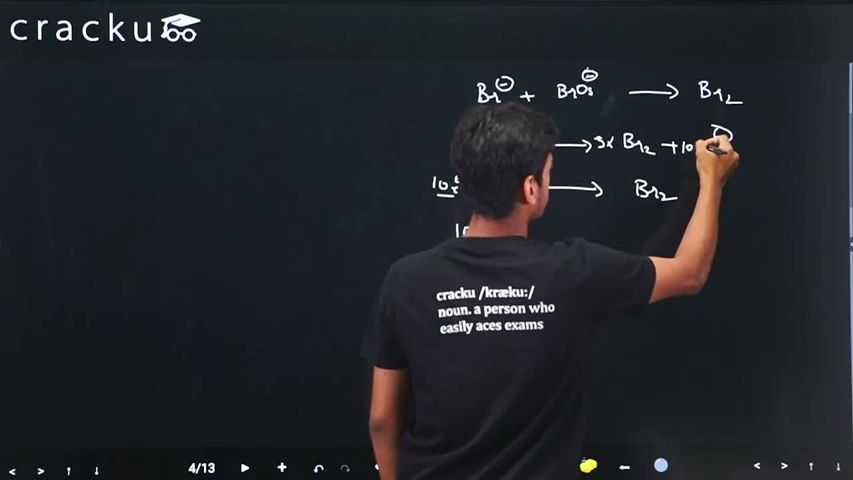
The mixture of $$KBr$$ and $$KBrO_3$$ behaves as an “in-situ” source of molecular bromine. In acidic medium the oxidation-reduction step is
$$5\,Br^- + BrO_3^- + 6\,H^+ \;\rightarrow\; 3\,Br_2 + 3\,H_2O$$
Thus, plenty of $$Br_2$$ is produced directly in the reaction vessel. Bromine water is well known to brominate activated aromatic rings.
(i) The −OH group of phenol is strongly $$+M$$ (electron-donating) and makes the benzene ring highly activated toward electrophilic substitution.
(ii) The resonance donation directs the incoming electrophile $$Br^+$$ to the ortho and para positions.
Because the concentration of bromine is high (generated continuously) and the reaction is carried out in aqueous medium, the first bromination happens almost instantaneously. The product formed (bromophenol) is still strongly activated, so successive brominations occur at the remaining two activated positions without the need for additional reagents.
Consequently all three ortho/para positions become substituted, giving
$$\text{Phenol} \xrightarrow[\text{aq.}]{KBr + KBrO_3,\; \Delta} \; 2,4,6\text{-tribromophenol}$$
Hence the major product is 2,4,6-tribromophenol.
Option C which is: 2, 4, 6-Tribromophenol
Was this solution helpful?
Click on the Email ☝️ to Watch the Video Solution
Create a FREE account and get:
_1.webp)

Educational materials for JEE preparation

Ask our AI anything

AI can make mistakes. Please verify important information.
AI can make mistakes. Please verify important information.


