
Join Our JEE Preparation Group
Prep with like-minded aspirants; Get access to free daily tests and study material.
Sign in
Please select an account to continue using cracku.in
↓ →
Join Our JEE Preparation Group
Prep with like-minded aspirants; Get access to free daily tests and study material.
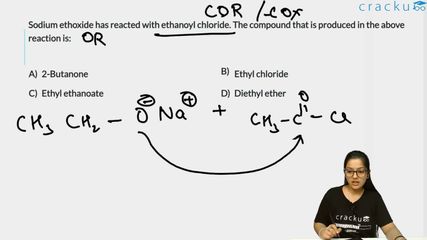
Sodium ethoxide has reacted with ethanoyl chloride. The compound that is produced in the above reaction is:
Ethanoyl chloride is an acyl chloride, $$CH_3COCl$$. Acyl chlorides undergo nucleophilic acyl-substitution reactions very readily.
Step 1 (identify the nucleophile): Sodium ethoxide is $$NaOCH_2CH_3$$. In solution it gives the strong nucleophile/strong base $$\;^-OCH_2CH_3$$ (ethoxide ion).
Step 2 (write the reaction):
$$CH_3COCl + \;^-OCH_2CH_3 \;\longrightarrow\; CH_3COOCH_2CH_3 + Cl^-$$
Step 3 (mechanism outline):
• The ethoxide ion attacks the electrophilic carbonyl carbon of $$CH_3COCl$$, forming a tetrahedral intermediate.
• The leaving group $$Cl^-$$ departs, restoring the carbonyl and giving the ester $$CH_3COOCH_2CH_3$$ (ethyl ethanoate).
• Sodium ion pairs with chloride ion to give the by-product $$NaCl$$.
Because an acyl chloride plus an alkoxide (or alcohol) always furnishes an ester, the product here must be the ester derived from ethanoyl chloride and ethanol/ethoxide, namely ethyl ethanoate.
The other options do not come from this reaction pathway:
• 2-Butanone (Option A) is a ketone, not formed in nucleophilic substitution of acyl chlorides.
• Ethyl chloride (Option B) would require substitution at ethoxide oxygen by chloride, which is not favored.
• Diethyl ether (Option D) comes from dehydration of ethanol, not from reaction with an acyl chloride.
Hence the product is ethyl ethanoate.
Option C which is: Ethyl ethanoate
Was this solution helpful?
Click on the Email ☝️ to Watch the Video Solution
Create a FREE account and get:
_1.webp)

Educational materials for JEE preparation

Ask our AI anything

AI can make mistakes. Please verify important information.
AI can make mistakes. Please verify important information.


