
Join Our JEE Preparation Group
Prep with like-minded aspirants; Get access to free daily tests and study material.
Sign in
Please select an account to continue using cracku.in
↓ →
Join Our JEE Preparation Group
Prep with like-minded aspirants; Get access to free daily tests and study material.
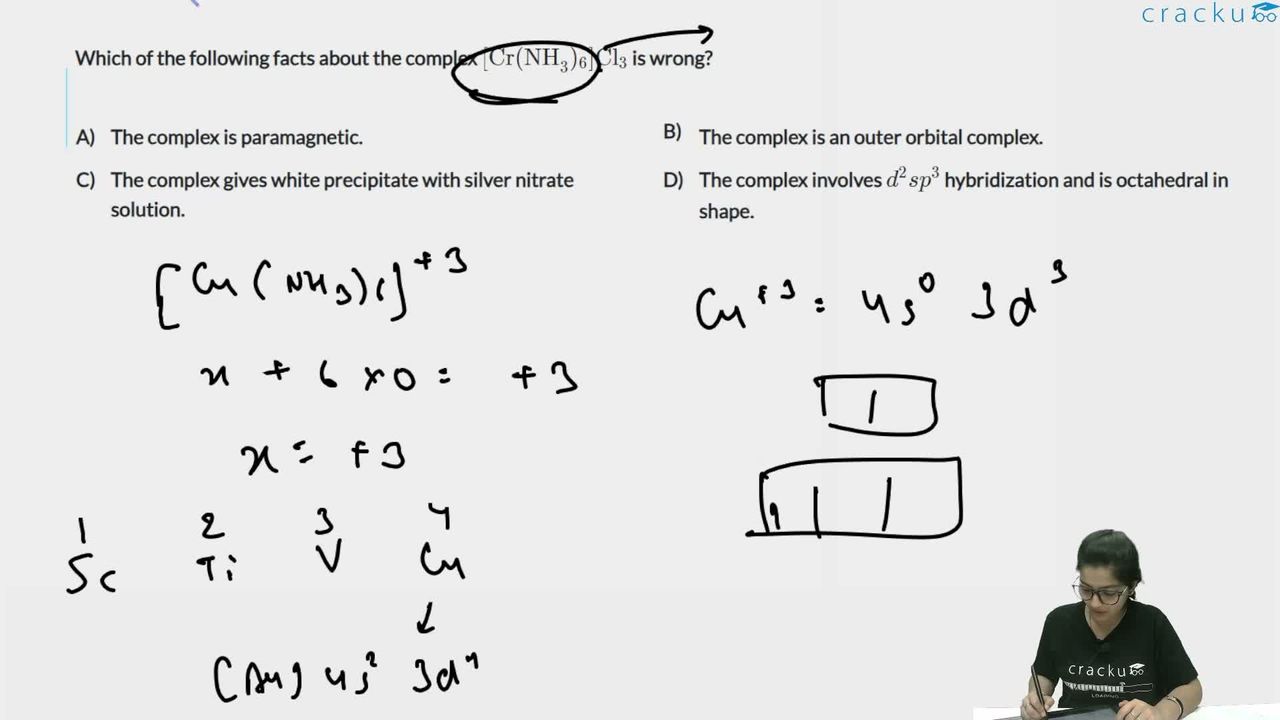
Which of the following facts about the complex $$[\text{Cr(NH}_3)_6]\text{Cl}_3$$ is wrong?
The complex is $$[\text{Cr(NH}_3)_6]\text{Cl}_3$$. The three chloride ions lie outside the coordination sphere, while all six $$NH_3$$ molecules are coordinated to chromium.
Oxidation state and electronic configuration
The charge on the complex cation is +3, so the oxidation state of chromium is +3.
Atomic chromium: $$\,[Ar]\,3d^{5}\,4s^{1}$$
After losing three electrons: $$\text{Cr}^{3+}:[Ar]\,3d^{3}$$
Paramagnetism
For an octahedral ion, the three 3d electrons of $$\text{Cr}^{3+}$$ occupy the $$t_{2g}$$ set as $$t_{2g}^{3}e_{g}^{0}$$ (one electron in each $$t_{2g}$$ orbital). Hence there are three unpaired electrons, so the complex is paramagnetic. ― Statement A is correct.
Type of hybridisation
To obtain an octahedral arrangement using inner (n − 1)d orbitals, the metal must supply two empty 3d orbitals, one 4s orbital and three 4p orbitals. For $$\text{Cr}^{3+}$$ we still have two empty 3d orbitals because only three of the five 3d orbitals are occupied. Thus the hybridisation is $$d^{2}sp^{3}$$, making it an inner-orbital (low-spin) complex. ― Statement D is correct.
Outer vs inner orbital
Because 3d orbitals (inner shell) are used, the complex is an inner-orbital complex, not an outer-orbital one. ― Statement B is incorrect.
Reaction with silver nitrate
All three chloride ions are present as free counter-ions, so with $$AgNO_3$$ the complex gives three moles of white $$AgCl$$ precipitate per mole of complex. ― Statement C is correct.
Therefore, the wrong statement is:
Option B which is: The complex is an outer orbital complex.
Was this solution helpful?
Click on the Email ☝️ to Watch the Video Solution
Create a FREE account and get:
_1.webp)

Educational materials for JEE preparation

Ask our AI anything

AI can make mistakes. Please verify important information.
AI can make mistakes. Please verify important information.


