
Join Our JEE Preparation Group
Prep with like-minded aspirants; Get access to free daily tests and study material.
Sign in
Please select an account to continue using cracku.in
↓ →
Join Our JEE Preparation Group
Prep with like-minded aspirants; Get access to free daily tests and study material.
The ground-state electronic configuration of any element is obtained by filling the subshells in the order of increasing energy following the $$n + \ell$$ rule and applying Hund’s rule and the Pauli exclusion principle.
For the lanthanides (atomic numbers 57-71), electrons are added mainly to the $$4f$$ subshell while $$5d$$ and $$6s$$ remain close in energy. Gadolinium has atomic number $$Z = 64$$, so its 64 electrons must be distributed starting from $$1s$$ upward.
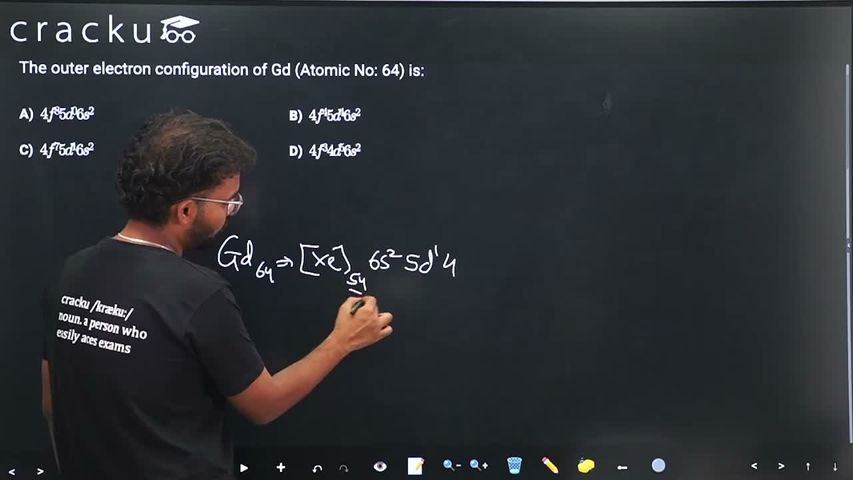
Till xenon ($$Z = 54$$) the configuration is complete: $$[Xe]$$.
Electrons $$55 \text{ to } 64$$ are then filled as follows:
• $$55^{\text{th}}$$ electron enters $$6s$$ ⇒ $$6s^1$$
• $$56^{\text{th}}$$ electron also enters $$6s$$ ⇒ $$6s^2$$ (now $$6s$$ is filled).
• Next electrons are expected to enter $$4f$$ because after $$6s$$ the $$4f$$ and $$5d$$ subshells are very close in energy. According to the usual order, we begin to fill $$4f$$: $$4f^1, 4f^2, \dots$$
This continues until we have introduced seven electrons into $$4f$$. The half-filled $$4f^7$$ configuration provides extra stability (Hund’s rule for maximum multiplicity).
After reaching the half-filled state, the next electron preferentially goes to the nearby higher subshell $$5d$$ rather than pairing inside $$4f$$; this again keeps energy minimum because both $$4f$$ (half-filled) and $$5d$$ (now singly occupied) achieve relatively stable arrangements.
Thus electrons $$55$$ to $$64$$ are distributed as:
$$6s^2$$ (2 electrons) + $$4f^7$$ (7 electrons) + $$5d^1$$ (1 electron) → 10 electrons in total, matching $$64 - 54 = 10$$.
Hence the outer (valence-shell) electronic configuration of gadolinium is
$$[Xe]\,4f^7\,5d^1\,6s^2$$.
Therefore, the correct choice is Option C which is: $$4f^7 5d^1 6s^2$$.
Was this solution helpful?
Click on the Email ☝️ to Watch the Video Solution
Create a FREE account and get:
_1.webp)

Educational materials for JEE preparation

Ask our AI anything

AI can make mistakes. Please verify important information.
AI can make mistakes. Please verify important information.


