
Join Our JEE Preparation Group
Prep with like-minded aspirants; Get access to free daily tests and study material.
Sign in
Please select an account to continue using cracku.in
↓ →
Join Our JEE Preparation Group
Prep with like-minded aspirants; Get access to free daily tests and study material.
Match List - I with List - II.
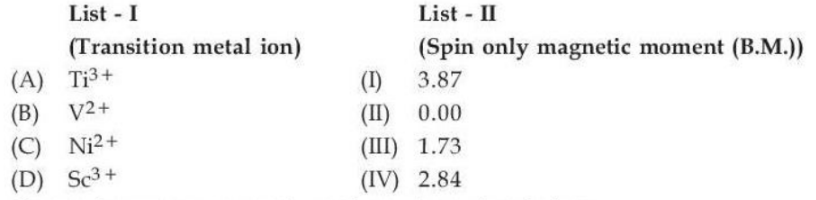
Choose the correct answer from the options given below :
List - I contains four familiar salts of the d-block elements and List - II lists the characteristic colours shown by those salts.
Case A (Compound : $$\text{KMnO}_4$$)
The manganate(VII) ion $$\text{MnO}_4^-$$ has an $$n \rightarrow \pi^{*}$$ charge-transfer transition whose absorption lies in the green region of the spectrum; the transmitted (complementary) colour is therefore purple. Hence,
$$\text{KMnO}_4$$ → Purple colour (Entry III).
Case B (Compound : $$\text{K}_2\text{Cr}_2\text{O}_7$$)
The dichromate ion $$\text{Cr}_2\text{O}_7^{2-}$$ shows ligand-to-metal charge-transfer bands that make the solution absorb mainly in the violet-blue region; the observed colour is orange. Hence,
$$\text{K}_2\text{Cr}_2\text{O}_7$$ → Orange colour (Entry I).
Case C (Compound : $$\text{FeSO}_4\cdot7\text{H}_2\text{O}$$)
In ferrous sulphate the ion present is the high-spin octahedral $$\text{Fe}^{2+}$$ (d6). A weak d-d transition in the red part of the spectrum makes the crystalline salt appear light (pale) green. Hence,
$$\text{FeSO}_4\cdot7\text{H}_2\text{O}$$ → Light green colour (Entry IV).
Case D (Compound : $$\text{CuSO}_4\cdot5\text{H}_2\text{O}$$)
Aqueous copper(II) ion, present as $$[\text{Cu(H}_2\text{O})_6]^{2+}$$, undergoes an octahedral d-d transition that absorbs in the orange-red region, imparting an intense blue colour to the salt. Hence,
$$\text{CuSO}_4\cdot5\text{H}_2\text{O}$$ → Blue colour (Entry II).
Therefore the required matching is:
(A) − (III), (B) − (I), (C) − (IV), (D) − (II)
Option A which is: (A) − (III), (B) − (I), (C) − (IV), (D) − (II)
Was this solution helpful?
Create a FREE account and get:
_1.webp)

Educational materials for JEE preparation

Ask our AI anything

AI can make mistakes. Please verify important information.
AI can make mistakes. Please verify important information.
