Sign in
Please select an account to continue using cracku.in
↓ →
In Young's double slit experiment, a fine beam of coherent monochromatic light of wavelength $$\lambda = 600\,\text{nm}$$ is incident on identical slits $$S_1$$ and $$S_2$$ at separation $$d$$. The intensity at the central maximum formed at $$O$$ is $$I_{\max}$$ and the angular fringe width is $$\beta = 0.1^\circ$$. When a thin transparent film is placed in front of the slit $$S_2$$, the intensity at $$O$$ changes. It is found that the smallest thickness of the film, for which the intensity at $$O$$ becomes half the maximum intensity $$\frac{I_{\max}}{2}$$, is $$250\,\text{nm}$$. Neglecting the absorption of light by the film, the zero order fringe earlier at $$O$$ now forms at $$O'$$ where $$OO' = 0.5\,\text{mm}$$. Choose correct option or options.
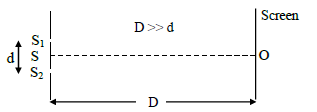
_1.webp)

Start your IIM journey with the right preparation and crack CAT 2026.

Educational materials for JEE preparation

Ask our AI anything

AI can make mistakes. Please verify important information.
AI can make mistakes. Please verify important information.
 91- 6303239042