
Join Our JEE Preparation Group
Prep with like-minded aspirants; Get access to free daily tests and study material.
Sign in
Please select an account to continue using cracku.in
↓ →
Join Our JEE Preparation Group
Prep with like-minded aspirants; Get access to free daily tests and study material.
The rate of a chemical reaction doubles for every $$10^\circ \text{C}$$ rise of temperature. If the temperature is raised by $$50^\circ \text{C}$$, the rate of the reaction increases by about:
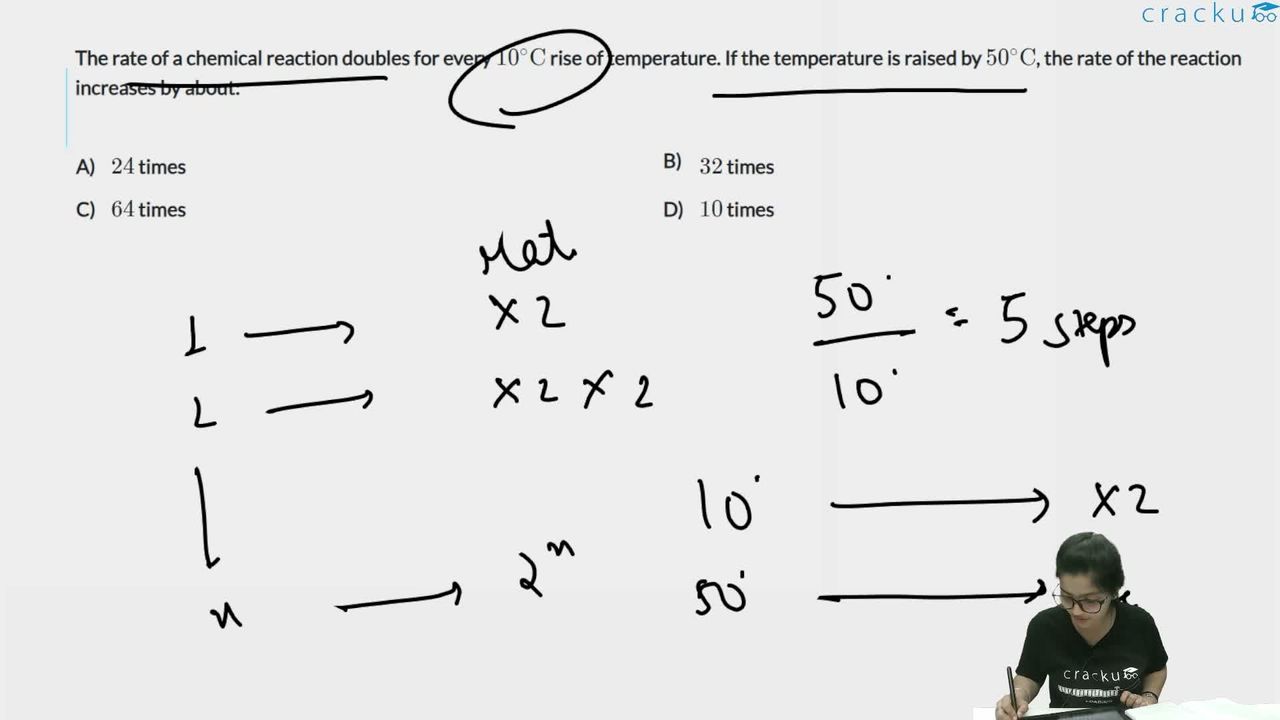
The empirical rule for many reactions states: for every $$10^\circ \text{C}$$ rise in temperature, the rate constant (and hence the rate) becomes twice its previous value.
Given a total temperature rise of $$50^\circ \text{C}$$, we can divide this rise into five successive $$10^\circ \text{C}$$ steps:
Number of steps $$= \frac{50^\circ \text{C}}{10^\circ \text{C}} = 5$$.
If the rate after one step is multiplied by $$2$$, then after $$n$$ identical steps the overall multiplication factor is $$2^n$$.
Thus, for $$n = 5$$ steps:
Overall rate increase factor $$= 2^5 = 32$$.
Hence the rate of the reaction becomes $$32$$ times its original value when the temperature is raised by $$50^\circ \text{C}$$.
Option B which is: $$32$$ times
Was this solution helpful?
Click on the Email ☝️ to Watch the Video Solution
Create a FREE account and get:
_1.webp)

Educational materials for JEE preparation

Ask our AI anything

AI can make mistakes. Please verify important information.
AI can make mistakes. Please verify important information.


