
Join Our JEE Preparation Group
Prep with like-minded aspirants; Get access to free daily tests and study material.
Sign in
Please select an account to continue using cracku.in
↓ →
Join Our JEE Preparation Group
Prep with like-minded aspirants; Get access to free daily tests and study material.
For the hydrogen electrode the half-reaction is
$$2\,\text{H}^{+}(aq)+2e^- \rightarrow \text{H}_2(g)$$
The Nernst equation at $$298\text{ K}$$ is
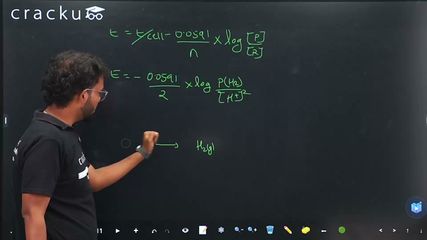
$$E = E^{\circ} - \frac{0.0591}{n}\,\log Q$$
where $$n = 2$$ and the reaction quotient is
$$Q = \frac{p(\text{H}_2)}{[\text{H}^+]^{2}}$$
Because $$E^{\circ}=0\,$$ V for a standard hydrogen electrode, we get
$$E = -\frac{0.0591}{2}\,\log\!\left(\frac{p(\text{H}_2)}{[\text{H}^+]^{2}}\right) \qquad -(1)$$
The sign of $$E$$ depends only on the sign of the logarithm:
• If $$\log(\ldots) \gt 0$$, the quantity inside is >1 and the term subtracted in (1) is positive, making $$E$$ negative.
• If $$\log(\ldots) \lt 0$$, the ratio is <1 and $$E$$ becomes positive.
Evaluate each option:
Option A: $$p=1\,\text{atm},\;[\text{H}^+]=1\,\text{M}$$
$$\frac{p}{[\text{H}^+]^{2}} = \frac{1}{1^{2}} = 1\;\Longrightarrow\;\log 1 = 0$$
Hence $$E = 0$$ (neither positive nor negative).
Option B: $$p=2\,\text{atm},\;[\text{H}^+]=1\,\text{M}$$
$$\frac{p}{[\text{H}^+]^{2}} = \frac{2}{1^{2}} = 2\;\Longrightarrow\;\log 2 \gt 0$$
In (1) we subtract a positive number, so $$E$$ is negative.
Option C: $$p=2\,\text{atm},\;[\text{H}^+]=2\,\text{M}$$
$$\frac{p}{[\text{H}^+]^{2}} = \frac{2}{(2)^{2}} = 0.5\;\Longrightarrow\;\log 0.5 \lt 0$$
Subtracting a negative value makes $$E$$ positive.
Option D: $$p=1\,\text{atm},\;[\text{H}^+]=2\,\text{M}$$
$$\frac{p}{[\text{H}^+]^{2}} = \frac{1}{(2)^{2}} = 0.25\;\Longrightarrow\;\log 0.25 \lt 0$$
Again $$E$$ is positive.
Only Option B yields a positive logarithm and therefore a negative electrode potential.
Final answer: Option B which is: $$p(\text{H}_2)=2\,\text{atm}$$ and $$[\text{H}^+]=1.0\,\text{M}$$.
Was this solution helpful?
Click on the Email ☝️ to Watch the Video Solution
Create a FREE account and get:
_1.webp)

Educational materials for JEE preparation

Ask our AI anything

AI can make mistakes. Please verify important information.
AI can make mistakes. Please verify important information.


