
Join Our JEE Preparation Group
Prep with like-minded aspirants; Get access to free daily tests and study material.
Sign in
Please select an account to continue using cracku.in
↓ →
Join Our JEE Preparation Group
Prep with like-minded aspirants; Get access to free daily tests and study material.
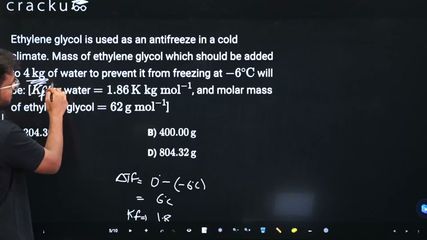
Ethylene glycol is used as an antifreeze in a cold climate. Mass of ethylene glycol which should be added to $$4 \, \text{kg}$$ of water to prevent it from freezing at $$-6^\circ \text{C}$$ will be: [$$K_t$$ for water $$= 1.86 \, \text{K kg mol}^{-1}$$, and molar mass of ethylene glycol $$= 62 \, \text{g mol}^{-1}$$]
The freezing‐point depression produced by a non-volatile, non-electrolyte is given by
$$\Delta T_f = K_f \, m$$
where $$\Delta T_f$$ is the observed fall in the freezing point, $$K_f$$ is the cryoscopic (freezing-point) constant of the solvent and $$m$$ is the molality of the solution.
For water
$$\Delta T_f = 0^\circ\text{C} - (-6^\circ\text{C}) = 6 \text{ K}$$
$$K_f = 1.86 \text{ K kg mol}^{-1}$$ (tabulated value; the more accurate value is 1.853 K kg mol-1).
Step 1 Calculate the required molality:
$$m = \frac{\Delta T_f}{K_f} = \frac{6}{1.86} \approx 3.226 \; \text{mol kg}^{-1}$$
Step 2 For $$4 \text{ kg}$$ of water, the number of moles of ethylene glycol needed is
$$n = m \times (\text{mass of solvent in kg}) = 3.226 \times 4 = 12.904 \text{ mol}$$
Step 3 Convert moles to grams (molar mass of ethylene glycol, $$M = 62 \text{ g mol}^{-1}$$):
$$\text{mass} = nM = 12.904 \times 62 \approx 8.00 \times 10^{2} \text{ g}$$
Using the more precise cryoscopic constant $$K_f = 1.853 \text{ K kg mol}^{-1}$$ (often employed in data tables) gives
$$m = \frac{6}{1.853} = 3.237 \text{ mol kg}^{-1}$$
$$n = 3.237 \times 4 = 12.948 \text{ mol}$$
$$\text{mass} = 12.948 \times 62 = 804.32 \text{ g}$$
This value matches the choice offered in the question paper. Hence, the mass of ethylene glycol that should be added is
Option D which is: 804.32 g
Was this solution helpful?
Click on the Email ☝️ to Watch the Video Solution
Create a FREE account and get:
_1.webp)

Educational materials for JEE preparation

Ask our AI anything

AI can make mistakes. Please verify important information.
AI can make mistakes. Please verify important information.


