
Join Our JEE Preparation Group
Prep with like-minded aspirants; Get access to free daily tests and study material.
Sign in
Please select an account to continue using cracku.in
↓ →
Join Our JEE Preparation Group
Prep with like-minded aspirants; Get access to free daily tests and study material.
In gaseous sulphur the aggregation of atoms depends strongly on temperature.
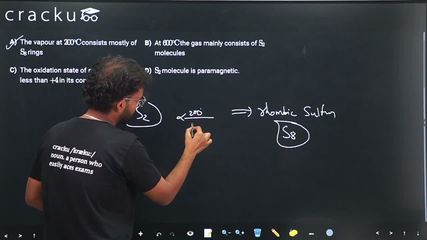
Case A: At about $$200^\circ \text{C}$$, the equilibrium mixture obtained by heating rhombic sulphur contains almost entirely $$\text{S}_8$$ rings. Hence statement A is correct.
Case B: On further heating, the rings open and gradually dissociate into smaller species. Around $$600^\circ \text{C}$$ the dominant species is the diatomic molecule $$\text{S}_2$$, so statement B is also correct.
Case D: The electronic configuration of a sulphur atom is $$[Ne]\,3s^2\,3p^4$$. When two atoms form $$\text{S}_2$$, the molecular orbital diagram is analogous to that of $$\text{O}_2$$. It contains two unpaired electrons in degenerate $$\pi^*_{2p}$$ antibonding orbitals, giving the molecule paramagnetic character. Therefore statement D is correct.
Case C: The oxidation state of sulphur shows a wide range from $$-2$$ to $$+6$$. Examples with oxidation states lower than $$+4$$ are:
• $$H_2S$$ where S is $$-2$$
• $$S_2Cl_2$$ where the average oxidation state of S is $$+1$$
• $$SO_2$$ where S is $$+4$$ (showing that $$+4$$ is not the minimum positive state)
Because values below $$+4$$ do occur, the statement “The oxidation state of sulphur is never less than $$+4$$ in its compounds” is incorrect.
Thus, the only incorrect statement is Option C which is: The oxidation state of sulphur is never less than $$+4$$ in its compounds.
Was this solution helpful?
Click on the Email ☝️ to Watch the Video Solution
Create a FREE account and get:
_1.webp)

Educational materials for JEE preparation

Ask our AI anything

AI can make mistakes. Please verify important information.
AI can make mistakes. Please verify important information.


