
Join Our JEE Preparation Group
Prep with like-minded aspirants; Get access to free daily tests and study material.
Sign in
Please select an account to continue using cracku.in
↓ →
Join Our JEE Preparation Group
Prep with like-minded aspirants; Get access to free daily tests and study material.
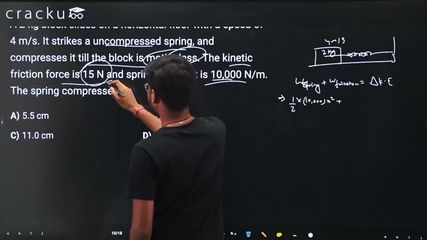
A 2 kg block slides on a horizontal floor with a speed of 4 m/s. It strikes a uncompressed spring, and compresses it till the block is motionless. The kinetic friction force is 15 N and spring constant is 10,000 N/m. The spring compresses by
According to the Work-Energy Theorem, the net work done by all forces acting on a body is equal to the change in its kinetic energy:
$$W_{\text{net}} = \Delta K$$
$$W_{\text{spring}} + W_{\text{friction}} = K_{\text{final}} - K_{\text{initial}}$$
Let $$x$$ be the maximum compression of the spring in meters ($$\text{m}$$) at the instant the block is brought completely to rest. Let us define the physical parameters from the problem statement:
We substitute the mathematical expressions for each work component into the energy conservation layout:
Substituting these into the relation yields:
$$-\frac{1}{2} \cdot k \cdot x^2 - f_k \cdot x = 0 - \frac{1}{2} \cdot m \cdot v^2$$
Multiply the entire equation by $$-1$$ to make the coefficients positive:
$$\frac{1}{2} \cdot k \cdot x^2 + f_k \cdot x = \frac{1}{2} \cdot m \cdot v^2$$
Now, plug in the numerical values into the equation:
$$\frac{1}{2} \cdot (10,000) \cdot x^2 + 15 \cdot x = \frac{1}{2} \cdot (2) \cdot (4)^2$$
$$5000 \cdot x^2 + 15 \cdot x = 16$$
$$5000 \cdot x^2 + 15 \cdot x - 16 = 0$$
Using the general quadratic formula $$x = \frac{-b \pm \sqrt{b^2 - 4ac}}{2a}$$ to find the roots of our equation:
$$x = \frac{-15 \pm \sqrt{(15)^2 - 4 \cdot (5000) \cdot (-16)}}{2 \cdot 5000}$$
$$x = \frac{-15 \pm \sqrt{225 + 320,000}}{10,000}$$
$$x = \frac{-15 \pm \sqrt{320,225}}{10,000}$$
Since $$\sqrt{320,225} \approx 565.88$$, and discarding the negative root as compression length must be positive:
$$x = \frac{-15 + 565.88}{10,000}$$
$$x = \frac{550.88}{10,000} \approx 0.0551 \,\, \text{m}$$
To convert the calculated SI unit value from meters to centimeters ($$\text{cm}$$), we multiply the result by $$100$$:
$$x = 0.0551 \cdot 100 \,\, \text{cm} \approx 5.5 \,\, \text{cm}$$
Concept Check: The initial kinetic energy of the block ($$16 \,\, \text{J}$$) is split between storing elastic potential energy inside the spring and overcoming the resistive drag of friction. Because the spring constant is exceptionally stiff ($$10,000 \,\, \text{N/m}$$), the total stopping distance is restricted to a small displacement of just $$5.5 \,\, \text{cm}$$.
Correct Option Key: Option A ($$5.5 \,\, \text{cm}$$)
Was this solution helpful?
Click on the Email ☝️ to Watch the Video Solution
Create a FREE account and get:
_1.webp)

Educational materials for JEE preparation

Ask our AI anything

AI can make mistakes. Please verify important information.
AI can make mistakes. Please verify important information.
