
Join Our JEE Preparation Group
Prep with like-minded aspirants; Get access to free daily tests and study material.
Sign in
Please select an account to continue using cracku.in
↓ →
Join Our JEE Preparation Group
Prep with like-minded aspirants; Get access to free daily tests and study material.
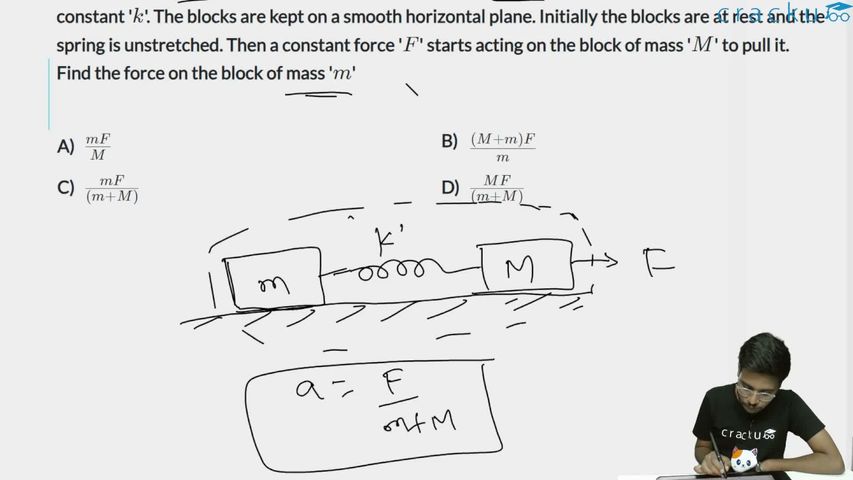
A block of mass '$$m$$' is connected to another block of mass '$$M$$' by a spring (massless) of spring constant '$$k$$'. The blocks are kept on a smooth horizontal plane. Initially the blocks are at rest and the spring is unstretched. Then a constant force '$$F$$' starts acting on the block of mass '$$M$$' to pull it. Find the force on the block of mass '$$m$$'
We have two blocks of masses $$m$$ and $$M$$ placed on a smooth horizontal plane and connected by a massless spring. A constant external force $$F$$ is applied to pull the block of mass $$M$$.
To find the overall acceleration ($$a$$) of the two-block system, we treat both blocks and the spring together as a single composite system. Since the horizontal surface is perfectly smooth, there are no frictional forces opposing the movement.
According to Newton's Second Law of Motion, the net external force equals the total mass of the system multiplied by its common acceleration:
$$F = (M + m) \cdot a$$
Isolating the acceleration variable ($$a$$):
$$a = \frac{F}{M + m}$$
Now, let us isolate and analyze the block of mass $$m$$ using a free-body diagram. The only horizontal force acting on mass $$m$$ is the pulling force exerted by the connecting spring ($$F_{\text{spring}}$$).
Since this block moves with the same common acceleration ($$a$$) computed above, we apply Newton's Second Law specifically to mass $$m$$:
$$F_{\text{on } m} = m \cdot a$$
Substituting the expression for acceleration ($$a = \frac{F}{M + m}$$) into this equation yields:
$$F_{\text{on } m} = m \cdot \left( \frac{F}{M + m} \right) = \frac{m \cdot F}{M + m}$$
Concept Check: The spring serves as an intermediary transmitter of force. The constant external force $$F$$ accelerates the combined inertia of both blocks, meaning the fraction of the total force transferred to the rear mass $$m$$ depends directly on its proportional contribution to the total mass of the system.
Correct Option Key: Option C ($$\frac{m \cdot F}{m + M}$$)
Was this solution helpful?
Click on the Email ☝️ to Watch the Video Solution
Create a FREE account and get:
_1.webp)

Educational materials for JEE preparation

Ask our AI anything

AI can make mistakes. Please verify important information.
AI can make mistakes. Please verify important information.
