
Join Our JEE Preparation Group
Prep with like-minded aspirants; Get access to free daily tests and study material.
Sign in
Please select an account to continue using cracku.in
↓ →
Join Our JEE Preparation Group
Prep with like-minded aspirants; Get access to free daily tests and study material.
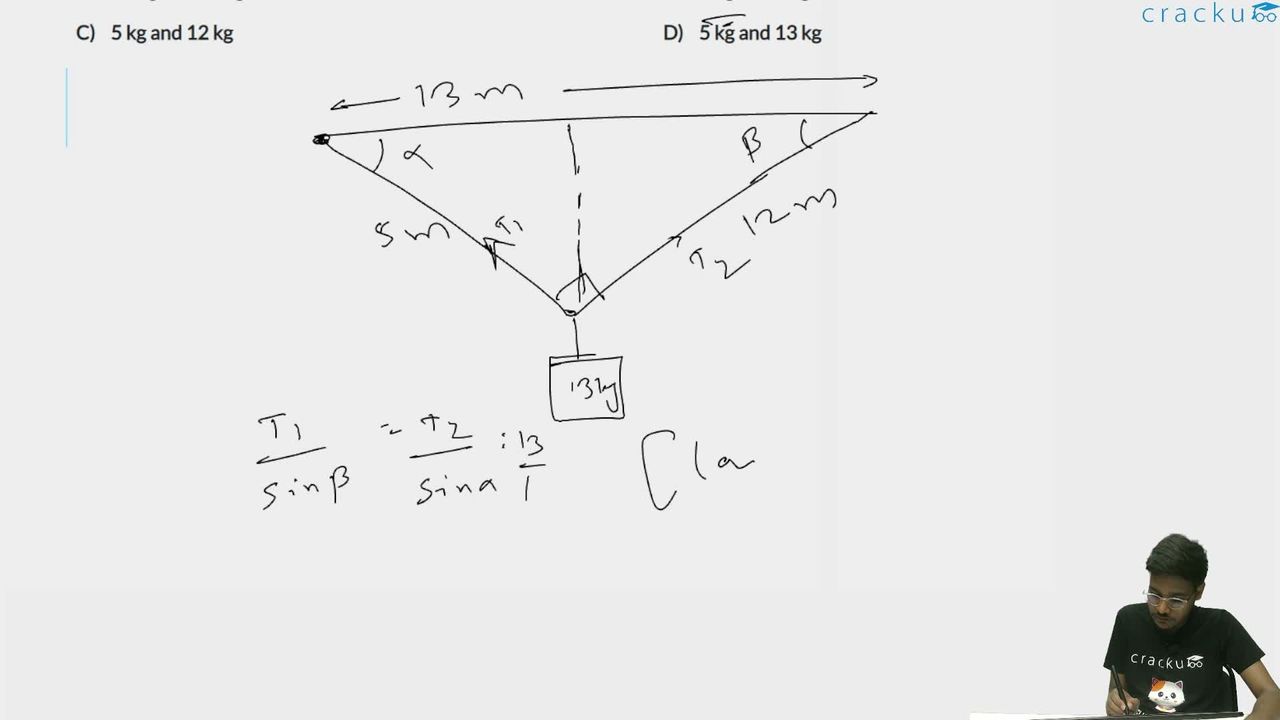
A body weighing 13 kg is suspended by two strings 5 m and 12 m long, their other ends being fastened to the extremities of a rod 13 m long. If the rod be so held that the body hangs immediately below the middle point. The tensions in the strings are
Let the rod be represented by the horizontal line segment $$AB$$ of length $$c = 13 \,\, \text{m}$$. The body is suspended from the extremities $$A$$ and $$B$$ by two strings:
Let the two strings meet at point $$C$$, where the body of weight $$W = 13 \,\, \text{kg}$$ hangs. This forms a triangle $$\triangle ABC$$. Let us check the relationship between the side lengths using the Pythagorean theorem:
$$5^2 + 12^2 = 25 + 144 = 169$$
$$13^2 = 169$$
Since $$a^2 + b^2 = c^2$$, $$\triangle ABC$$ is a right-angled triangle with the right angle located at point $$C$$ ($$\angle ACB = 90^\circ$$).
The problem states that the rod is held in such a manner that the body hangs immediately below the middle point of the rod. Let $$M$$ be the midpoint of the rod $$AB$$.
Since the body hangs vertically under gravity, the line of action of its weight ($$W$$) passes vertically downward through $$C$$. For the system to hang in static equilibrium, the vertical line of action of the weight must pass directly through the midpoint $$M$$. Therefore, the median line $$CM$$ must be perfectly vertical.
In any right-angled triangle, the length of the median drawn to the hypotenuse is exactly equal to half the length of the hypotenuse:
$$CM = \frac{AB}{2} = \frac{13}{2} = 6.5 \,\, \text{m}$$
Also, since $$M$$ is the midpoint, $$AM = BM = 6.5 \,\, \text{m}$$. Thus, $$\triangle AMC$$ and $$\triangle BMC$$ are isosceles triangles ($$AM = CM$$ and $$BM = CM$$).
Let the angle that string $$AC$$ makes with the vertical line $$CM$$ be $$\alpha$$, and the angle that string $$BC$$ makes with the vertical line $$CM$$ be $$\beta$$.
$$\angle ACM = \angle CAM = \angle A$$
Therefore, $$\alpha = \angle A$$.
$$\angle BCM = \angle CBM = \angle B$$
Therefore, $$\beta = \angle B$$.
From the original right-angled triangle $$\triangle ABC$$, we can easily find the sine values of the internal angles:
$$\sin\alpha = \sin A = \frac{\text{Opposite}}{\text{Hypotenuse}} = \frac{BC}{AB} = \frac{12}{13}$$
$$\sin\beta = \sin B = \frac{\text{Opposite}}{\text{Hypotenuse}} = \frac{AC}{AB} = \frac{5}{13}$$
Let $$T_1$$ be the tension in string $$AC$$ and $$T_2$$ be the tension in string $$BC$$. Three coplanar forces ($$T_1$$, $$T_2$$, and the weight $$W = 13 \,\, \text{kg}$$) meet at point $$C$$ in equilibrium.
The angle between $$T_1$$ and the vertical line of action of the weight is $$180^\circ - \alpha$$, and the angle between $$T_2$$ and the vertical is $$180^\circ - \beta$$. The angle between the two strings is $$\angle ACB = 90^\circ$$. Applying Lami's Theorem:
$$\frac{T_1}{\sin(180^\circ - \beta)} = \frac{T_2}{\sin(180^\circ - \alpha)} = \frac{W}{\sin(90^\circ)}$$
Since $$\sin(180^\circ - \theta) = \sin\theta$$ and $$\sin(90^\circ) = 1$$:
$$\frac{T_1}{\sin\beta} = \frac{T_2}{\sin\alpha} = \frac{13}{1}$$
Now, substitute the sine values determined in Step 3:
$$T_1 = 13 \cdot \sin\beta = 13 \cdot \left(\frac{5}{13}\right) = 5 \,\, \text{kg}$$
$$T_2 = 13 \cdot \sin\alpha = 13 \cdot \left(\frac{12}{13}\right) = 12 \,\, \text{kg}$$
Concept Check: Because the geometry creates a perfect right-angled layout, the tensions track inversely to their respective string configurations to keep the central hanging node perfectly stable without tilting out of equilibrium.
Correct Option Key: Option C (5 kg and 12 kg)
Was this solution helpful?
Click on the Email ☝️ to Watch the Video Solution
Create a FREE account and get:
_1.webp)

Educational materials for JEE preparation

Ask our AI anything

AI can make mistakes. Please verify important information.
AI can make mistakes. Please verify important information.
