
Join Our JEE Preparation Group
Prep with like-minded aspirants; Get access to free daily tests and study material.
Sign in
Please select an account to continue using cracku.in
↓ →
Join Our JEE Preparation Group
Prep with like-minded aspirants; Get access to free daily tests and study material.
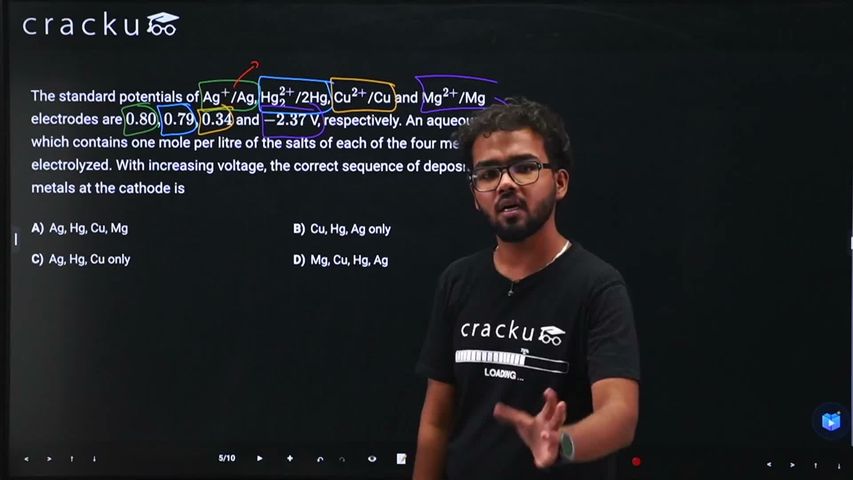
The standard potentials of Ag$$^+$$/Ag, Hg$$_2^{2+}$$/2Hg, Cu$$^{2+}$$/Cu and Mg$$^{2+}$$/Mg electrodes are $$0.80, 0.79, 0.34$$ and $$-2.37$$ V, respectively. An aqueous solution which contains one mole per litre of the salts of each of the four metals is electrolyzed. With increasing voltage, the correct sequence of deposition of the metals at the cathode is
The cathode is the electrode at which reduction takes place. For a series of metal ions present together, the ion having the highest (most positive) standard reduction potential $$E^{\circ}$$ is reduced (and hence deposited) first.
The given standard potentials (all in volts, 1 M, 298 K) are
$$Ag^{+} + e^{-} \rightarrow Ag \qquad E^{\circ}= +0.80$$
$$Hg_2^{2+} + 2e^{-} \rightarrow 2\,Hg \qquad E^{\circ}= +0.79$$
$$Cu^{2+} + 2e^{-} \rightarrow Cu \qquad E^{\circ}= +0.34$$
$$Mg^{2+} + 2e^{-} \rightarrow Mg \qquad E^{\circ}= -2.37$$
1. Starting from 0 V and gradually increasing the applied (cathodic) potential, the first reduction encountered is that with the largest positive $$E^{\circ}$$, namely $$Ag^{+}/Ag$$. Hence silver plates out first.
2. The next highest potential is only 0.01 V lower: $$Hg_2^{2+}/2Hg$$. As soon as the potential passes +0.79 V, mercurous ion is also reduced, so mercury is deposited second.
3. After still more negative potential is reached (beyond +0.34 V), copper(II) ions are reduced, so copper deposits third.
4. Before considering magnesium, compare its potential with the reduction of water. In neutral solution the reduction of water to hydrogen is $$2\,H_2O + 2e^{-} \rightarrow H_2 + 2\,OH^{-}, \qquad E^{\circ} \approx -0.83 \text{ V}$$ This value is much less negative than $$-2.37 \text{ V}$$ for $$Mg^{2+}/Mg$$. Therefore, long before the required potential for magnesium is reached, water is reduced and hydrogen gas is evolved. Magnesium metal will not deposit under normal aqueous electrolysis conditions.
Hence only Ag, Hg and Cu are obtained on the cathode surface, in that order.
Therefore the correct sequence is: Ag, Hg, Cu only.
Option C which is: Ag, Hg, Cu only
Was this solution helpful?
Click on the Email ☝️ to Watch the Video Solution
Create a FREE account and get:
_1.webp)

Educational materials for JEE preparation

Ask our AI anything

AI can make mistakes. Please verify important information.
AI can make mistakes. Please verify important information.
