
Join Our JEE Preparation Group
Prep with like-minded aspirants; Get access to free daily tests and study material.
Sign in
Please select an account to continue using cracku.in
↓ →
Join Our JEE Preparation Group
Prep with like-minded aspirants; Get access to free daily tests and study material.
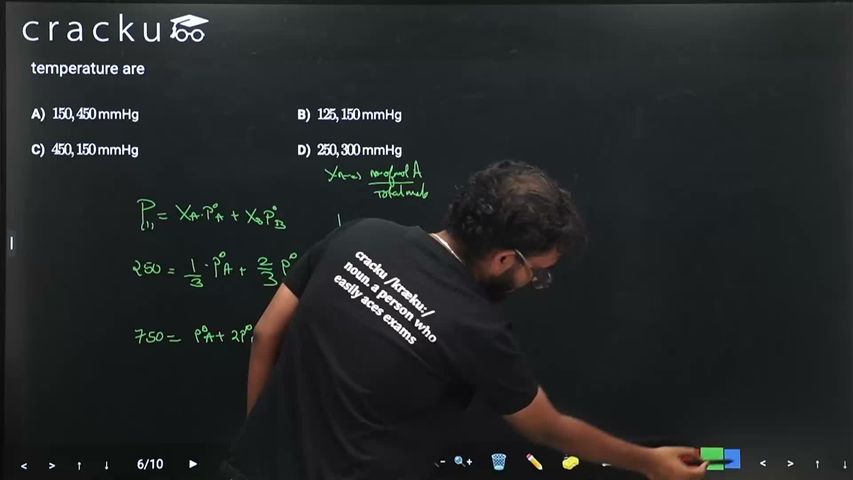
Liquids A and B form an ideal solution. At $$30^\circ C$$, the total vapour pressure of a solution containing $$1$$ mol of A and $$2$$ mol of B is $$250$$ mmHg. The total vapour pressure becomes $$300$$ mmHg when $$1$$ more mol of A is added to the first solution. The vapour pressures of pure A and B at the same temperature are
For an ideal liquid solution Raoult’s law gives, for every component,
$$p_i = x_i\,P_i^{*}$$ where $$x_i$$ is the mole-fraction in the liquid phase and $$P_i^{*}$$ is the vapour pressure of the pure liquid at the same temperature.
Hence the total vapour pressure is the sum of all partial pressures:
$$P_{\text{total}} = x_A\,P_A^{*} + x_B\,P_B^{*}$$
Case 1: 1 mol A + 2 mol B
Total moles $$= 1+2 = 3$$
$$x_A = \frac{1}{3},\; x_B = \frac{2}{3}$$
Given $$P_{\text{total}} = 250\ \text{mmHg}$$
$$\frac{1}{3}\,P_A^{*} + \frac{2}{3}\,P_B^{*} = 250$$
Multiplying by 3:
$$P_A^{*} + 2P_B^{*} = 750 \quad -(1)$$
Case 2: 1 mol more of A added → 2 mol A + 2 mol B
Total moles $$= 2+2 = 4$$
$$x_A = \frac{2}{4} = \frac{1}{2},\; x_B = \frac{1}{2}$$
Given $$P_{\text{total}} = 300\ \text{mmHg}$$
$$\frac{1}{2}\,P_A^{*} + \frac{1}{2}\,P_B^{*} = 300$$
Multiplying by 2:
$$P_A^{*} + P_B^{*} = 600 \quad -(2)$$
Subtract equation (2) from equation (1):
$$(P_A^{*} + 2P_B^{*}) - (P_A^{*} + P_B^{*}) = 750 - 600$$
$$P_B^{*} = 150\ \text{mmHg}$$
Substitute $$P_B^{*}=150$$ mmHg in equation (2):
$$P_A^{*} + 150 = 600 \;\Longrightarrow\; P_A^{*} = 450\ \text{mmHg}$$
Therefore, the vapour pressures of the pure liquids at $$30^\circ\text{C}$$ are:
A: $$450\ \text{mmHg},\;\; B:$$ $$150 \text{mmHg} $$
Option C which is: 450, 150 mmHg
Was this solution helpful?
Click on the Email ☝️ to Watch the Video Solution
Create a FREE account and get:
_1.webp)

Educational materials for JEE preparation

Ask our AI anything

AI can make mistakes. Please verify important information.
AI can make mistakes. Please verify important information.
