
Join Our JEE Preparation Group
Prep with like-minded aspirants; Get access to free daily tests and study material.
Sign in
Please select an account to continue using cracku.in
↓ →
Join Our JEE Preparation Group
Prep with like-minded aspirants; Get access to free daily tests and study material.
Ammonium chloride crystallizes in a body centred cubic lattice with edge length of unit cell of $$390$$ pm. If the size of chloride ion is $$180$$pm, the size of ammonium ion would be
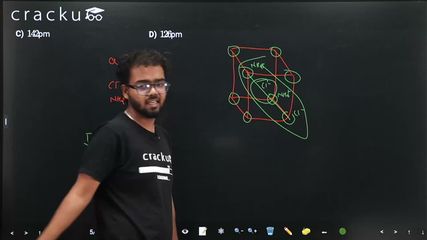
Ammonium chloride crystallizes in the CsCl-type structure (a body-centred cubic arrangement of two different ions).
In this lattice:
• The chloride ions $$Cl^-$$ occupy the eight corners of the cube.
• The ammonium ion $$NH_4^+$$ sits at the body centre.
• Along the body diagonal, a corner $$Cl^-$$ ion touches the central $$NH_4^+$$ ion, which in turn touches the opposite corner $$Cl^-$$ ion.
Hence, along the body diagonal we have the contact sequence
$$Cl^- \;|\; NH_4^+ \;|\; Cl^-$$
Let
$$r_- =$$ radius of $$Cl^- = 180\text{ pm}$$
$$r_+ =$$ radius of $$NH_4^+ = ?$$
$$a =$$ edge length of the cubic unit cell $$= 390\text{ pm}$$
The length of the body diagonal of a cube is given by the geometry formula
$$\text{body diagonal} = \sqrt{3}\,a$$
The same body diagonal is also equal to the sum of the three touching radii in sequence:
$$\text{body diagonal} = r_- + r_+ + r_- + r_+$$
$$\qquad\qquad\;\; = 2\,(r_- + r_+)$$
Equating the two expressions:
$$\sqrt{3}\,a = 2\,(r_- + r_+)$$
Substitute the numerical values:
$$\sqrt{3}\,(390) = 2\,(180 + r_+)$$
$$1.732 \times 390 = 2\,(180 + r_+)$$
$$675.48 = 360 + 2\,r_+$$
$$2\,r_+ = 675.48 - 360 = 315.48$$
$$r_+ = \frac{315.48}{2} \approx 157.7\text{ pm}$$
Rounded to the nearest whole number, the ionic radius of $$NH_4^+$$ is $$158\text{ pm}$$.
Option B which is: $$158\text{ pm}$$
Was this solution helpful?
Click on the Email ☝️ to Watch the Video Solution
Create a FREE account and get:
_1.webp)

Educational materials for JEE preparation

Ask our AI anything

AI can make mistakes. Please verify important information.
AI can make mistakes. Please verify important information.
