
Join Our JEE Preparation Group
Prep with like-minded aspirants; Get access to free daily tests and study material.
Sign in
Please select an account to continue using cracku.in
↓ →
Join Our JEE Preparation Group
Prep with like-minded aspirants; Get access to free daily tests and study material.
For a reaction $$A \rightarrow$$ Products, a plot of $$\log t_{1/2}$$ versus $$\log a_0$$ is shown in the figure. If the initial concentration of $$A$$ is represented by $$a_0$$, the order of the reaction is
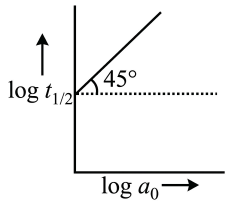
For every irreversible, non‐elementary reaction of the form $$A \rightarrow \text{Products}$$, the half-life $$t_{1/2}$$ depends on the initial concentration $$a_0$$ according to the rate law.
General relation between $$t_{1/2}$$ and $$a_0$$
If the reaction is of overall order $$n$$ (rate $$r = k\,a_0^{\,n}$$), the integrated rate expression gives
• For $$n = 1$$ (first order) : $$t_{1/2} = \dfrac{0.693}{k}$$ — independent of $$a_0$$.
• For $$n \neq 1$$ (zero, second, third, …) :
$$t_{1/2} = \dfrac{2^{\,n-1}-1}{(n-1)\,k\,a_0^{\,n-1}} \qquad -(1)$$
Log-log form
Taking common (base-10) logarithms of $$-(1)$$:
$$\log t_{1/2} = \log\!\left[\dfrac{2^{\,n-1}-1}{(n-1)\,k}\right] \;-\;(n-1)\,\log a_0 \qquad -(2)$$
Equation $$-(2)$$ is of the straight-line form $$y = c + m\,x$$ with
• ordinate $$y = \log t_{1/2}$$,
• abscissa $$x = \log a_0$$,
• slope $$m = -(n-1)$$.
Interpreting the given plot
The figure supplied in the question is a straight line whose slope is +1 (i.e. $$\log t_{1/2}$$ increases by one unit when $$\log a_0$$ increases by one unit).
Setting $$m = +1$$ in $$m = -(n-1)$$ gives
$$+1 = -(n-1) \;\Longrightarrow\; n - 1 = -1 \;\Longrightarrow\; n = 0$$.
Conclusion
The reaction is zero order.
Option B which is: zero
Was this solution helpful?
Create a FREE account and get:
_1.webp)

Educational materials for JEE preparation

Ask our AI anything

AI can make mistakes. Please verify important information.
AI can make mistakes. Please verify important information.
