
Join Our JEE Preparation Group
Prep with like-minded aspirants; Get access to free daily tests and study material.
Sign in
Please select an account to continue using cracku.in
↓ →
Join Our JEE Preparation Group
Prep with like-minded aspirants; Get access to free daily tests and study material.
The freezing point of a 1.00 m aqueous solution of HF is found to be $$-1.91°C$$. The freezing point constant of water, $$K_f$$ is 1.86 K kg mol$$^{-1}$$. The percentage dissociation of HF at this concentration is
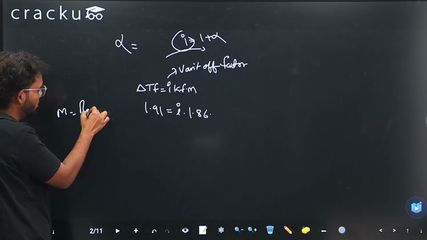
The depression in freezing point is related to the van’t Hoff factor $$i$$ by the formula
$$\Delta T_f = i\,K_f\,m$$
where $$\Delta T_f$$ is the fall in freezing point, $$K_f$$ is the cryoscopic constant of the solvent and $$m$$ is the molality of the solution.
Given data:
$$\Delta T_f = 1.91\;{\text{K}}$$ (because $$-1.91^{\circ}\text{C}$$ is a drop of 1.91 K)
$$K_f = 1.86\;{\text{K kg mol}}^{-1}$$
$$m = 1.00\;{\text{mol kg}}^{-1}$$
Calculate the van’t Hoff factor:
$$i = \frac{\Delta T_f}{K_f\,m} = \frac{1.91}{1.86 \times 1.00} = 1.02688 \;\approx\; 1.027$$
HF dissociates as $$HF \rightleftharpoons H^{+} + F^{-}$$
For one mole of HF, let the degree of dissociation be $$\alpha$$.
Initial moles: $$1$$ (HF only)
After dissociation: $$(1-\alpha)\;{\text{mol HF}},\; \alpha\;{\text{mol }}H^{+},\; \alpha\;{\text{mol }}F^{-}$$
Total moles of solute particles $$=\,(1-\alpha)+\alpha+\alpha = 1+\alpha$$
The general relation for a binary (1 → 2) dissociation is $$i = 1 + \alpha$$.
Equating with the experimental value:
$$1 + \alpha = 1.027$$
$$\alpha = 0.027$$
Percentage dissociation $$= \alpha \times 100\% = 0.027 \times 100\% = 2.7\%$$
Option D which is: 2.7%
Was this solution helpful?
Click on the Email ☝️ to Watch the Video Solution
Create a FREE account and get:
_1.webp)

Educational materials for JEE preparation

Ask our AI anything

AI can make mistakes. Please verify important information.
AI can make mistakes. Please verify important information.


