
Join Our JEE Preparation Group
Prep with like-minded aspirants; Get access to free daily tests and study material.
Sign in
Please select an account to continue using cracku.in
↓ →
Join Our JEE Preparation Group
Prep with like-minded aspirants; Get access to free daily tests and study material.
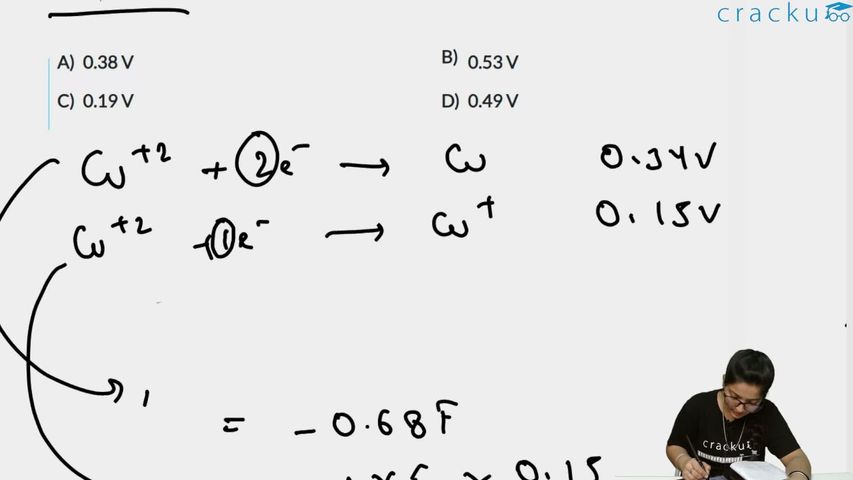
Given $$E^{\circ}_{Cu^{2+}/Cu} = 0.34$$ V, $$E^{\circ}_{Cu^{2+}/Cu^{+}} = 0.15$$ V. Standard electrode potential for the half cell $$Cu^{+}/Cu$$ is
Standard electrode potentials are intensive properties and cannot be added or subtracted directly. Instead, we must convert them into their corresponding Gibbs Free Energy changes ($$\Delta G^\circ$$), which are extensive properties and can be algebraically combined:
$$\Delta G^\circ = -nFE^\circ$$
Where:
Reaction 1: Reduction of $$\text{Cu}^{2+}$$ to $$\text{Cu}$$
$$\text{Cu}^{2+} + 2e^- \rightarrow \text{Cu} \quad \left(n_1 = 2, \ E^\circ_1 = 0.34\text{ V}\right)$$ $$\Delta G^\circ_1 = -2 \cdot F \cdot (0.34) = -0.68F$$Reaction 2: Reduction of $$\text{Cu}^{2+}$$ to $$\text{Cu}^+$$
$$\text{Cu}^{2+} + e^- \rightarrow \text{Cu}^+ \quad \left(n_2 = 1, \ E^\circ_2 = 0.15\text{ V}\right)$$ $$\Delta G^\circ_2 = -1 \cdot F \cdot (0.15) = -0.15F$$Reaction 3: Target Reduction of $$\text{Cu}^+$$ to $$\text{Cu}$$
$$\text{Cu}^+ + e^- \rightarrow \text{Cu} \quad \left(n_3 = 1, \ E^\circ_3 = ?\right)$$ $$\Delta G^\circ_3 = -1 \cdot F \cdot E^\circ_3$$By subtracting Reaction 2 from Reaction 1, we obtain our target Reaction 3:
$$\text{Reaction 3} = \text{Reaction 1} - \text{Reaction 2}$$
Therefore, their respective energy changes follow the same relationship:
$$\Delta G^\circ_3 = \Delta G^\circ_1 - \Delta G^\circ_2$$
Substitute the computed free energy values into the equation:
$$-1 \cdot F \cdot E^\circ_3 = -0.68F - (-0.15F)$$
$$-E^\circ_3 = -0.68 + 0.15$$
$$-E^\circ_3 = -0.53\text{ V}$$
$$E^\circ_3 = 0.53\text{ V}$$
The standard electrode potential for the half-cell $$\text{Cu}^+/\text{Cu}$$ is calculated to be $$0.53\text{ V}$$.
Correct Option: B — 0.53 V
Was this solution helpful?
Click on the Email ☝️ to Watch the Video Solution
Create a FREE account and get:
_1.webp)

Educational materials for JEE preparation

Ask our AI anything

AI can make mistakes. Please verify important information.
AI can make mistakes. Please verify important information.


