
Join Our JEE Preparation Group
Prep with like-minded aspirants; Get access to free daily tests and study material.
Sign in
Please select an account to continue using cracku.in
↓ →
Join Our JEE Preparation Group
Prep with like-minded aspirants; Get access to free daily tests and study material.
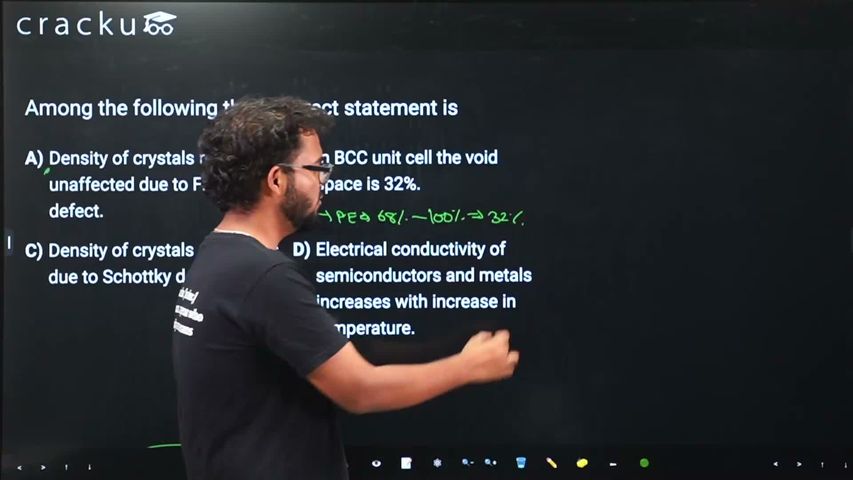
For an “incorrect statement” type question we must check every option against the standard facts of solid-state chemistry.
Option A : Frenkel defect involves displacement of a smaller ion (generally a cation) from its normal lattice point to an interstitial void.
• Mass of the unit cell remains unchanged (no ion leaves the crystal).
• Volume of the unit cell is also unchanged.
Hence density $$\rho=\frac{\text{mass}}{\text{volume}}$$ remains the same.
Statement A is correct.
Option B : Packing efficiency of a body-centred cubic (BCC) lattice is obtained from
$$\text{Packing efficiency}= \frac{\text{volume occupied by atoms}}{\text{volume of unit cell}}\times100\%$$
For BCC this value is $$68\%$$, therefore the unoccupied (void) space is $$100\%-68\% = 32\%$$. Statement B is correct.
Option C : A Schottky defect means equal numbers of cations and anions are missing from their lattice sites.
• Mass of the unit cell decreases (some ions have left).
• Unit-cell volume is unaffected.
Therefore density decreases.
Statement C is correct.
Option D : Temperature dependence of electrical conductivity ($$\sigma$$) is opposite for metals and intrinsic semiconductors.
• Metals: $$\sigma$$ decreases with increase in temperature because lattice vibrations (phonons) scatter conduction electrons more.
• Semiconductors: $$\sigma$$ increases with temperature because thermal energy generates more electron-hole pairs.
The statement “electrical conductivity of semiconductors and metals increases with temperature” is therefore wrong for metals. Statement D is incorrect.
Hence, the incorrect statement is:
Option D which is: Electrical conductivity of semiconductors and metals increases with increase in temperature.
Was this solution helpful?
Click on the Email ☝️ to Watch the Video Solution
Create a FREE account and get:
_1.webp)

Educational materials for JEE preparation

Ask our AI anything

AI can make mistakes. Please verify important information.
AI can make mistakes. Please verify important information.


