Join Our JEE Preparation Group
Prep with like-minded aspirants; Get access to free daily tests and study material.
Sign in
Please select an account to continue using cracku.in
↓ →
Join Our JEE Preparation Group
Prep with like-minded aspirants; Get access to free daily tests and study material.
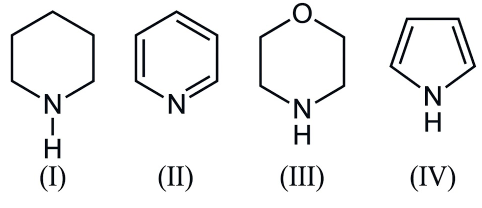
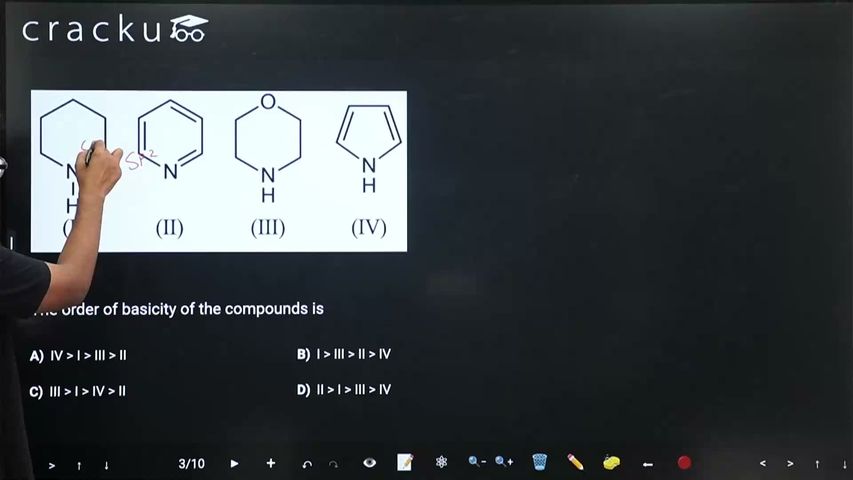
The four given bases are assumed to be
Case I: $$(CH_3)_2NH$$ (dimethylamine : a 2° aliphatic amine)
Case II: $$(CH_3)_3N$$ (trimethylamine : a 3° aliphatic amine)
Case III: $$CH_3NH_2$$ (methylamine : a 1° aliphatic amine)
Case IV: $$C_6H_5NH_2$$ (aniline : an aromatic amine)
Basicity of an amine in aqueous medium is governed mainly by two factors.
1. +I (electron-releasing) effect of alkyl groups
More alkyl groups push electron density toward the N-lone pair, increasing its availability for protonation.
2. Stabilisation of the conjugate acid by hydrogen bonding with water (solvation effect)
The conjugate acid $$R_3NH^+$$ must be well solvated. This requires N-H bonds that can form hydrogen bonds with water. Fewer N-H bonds mean poorer solvation and hence lower basicity.
Evaluating each compound
• Case I - dimethylamine, $$(CH_3)_2NH$$
Has two +I donating CH₃ groups and still possesses one N-H bond for effective solvation. Hence it is the most basic of the set.
• Case III - methylamine, $$CH_3NH_2$$
Only one +I group, but two N-H bonds give excellent solvation. It is slightly less basic than the 2° amine.
• Case II - trimethylamine, $$(CH_3)_3N$$
Although it has three +I groups, it has no N-H bond, so its conjugate acid is poorly solvated. Consequently its basicity falls below that of the 1° amine.
• Case IV - aniline, $$C_6H_5NH_2$$
The lone pair on N participates in resonance with the benzene ring:
$$C_6H_5NH_2 \;\rightleftharpoons\; C_6H_5{-}NH_2^{+} \,\, \text{(resonance forms)}$$
Delocalisation reduces electron density on N, making it the least basic.
Collecting the results:
$$\text{Basicity:} \; (CH_3)_2NH \; \gt \; CH_3NH_2 \; \gt \; (CH_3)_3N \; \gt \; C_6H_5NH_2$$
That matches
Option B which is: I > III > II > IV.
Was this solution helpful?
Click on the Email ☝️ to Watch the Video Solution
Create a FREE account and get:
_1.webp)

Educational materials for JEE preparation

Ask our AI anything

AI can make mistakes. Please verify important information.
AI can make mistakes. Please verify important information.