Join Our JEE Preparation Group
Prep with like-minded aspirants; Get access to free daily tests and study material.
Sign in
Please select an account to continue using cracku.in
↓ →
Join Our JEE Preparation Group
Prep with like-minded aspirants; Get access to free daily tests and study material.
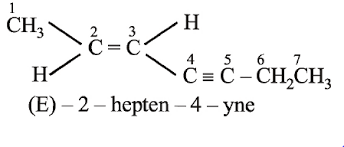
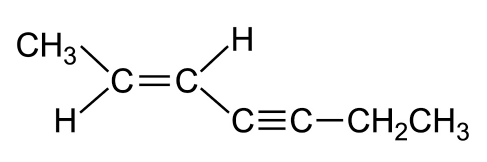
The continuous carbon chain contains 7 carbon atoms, which corresponds to the parent root word hept.
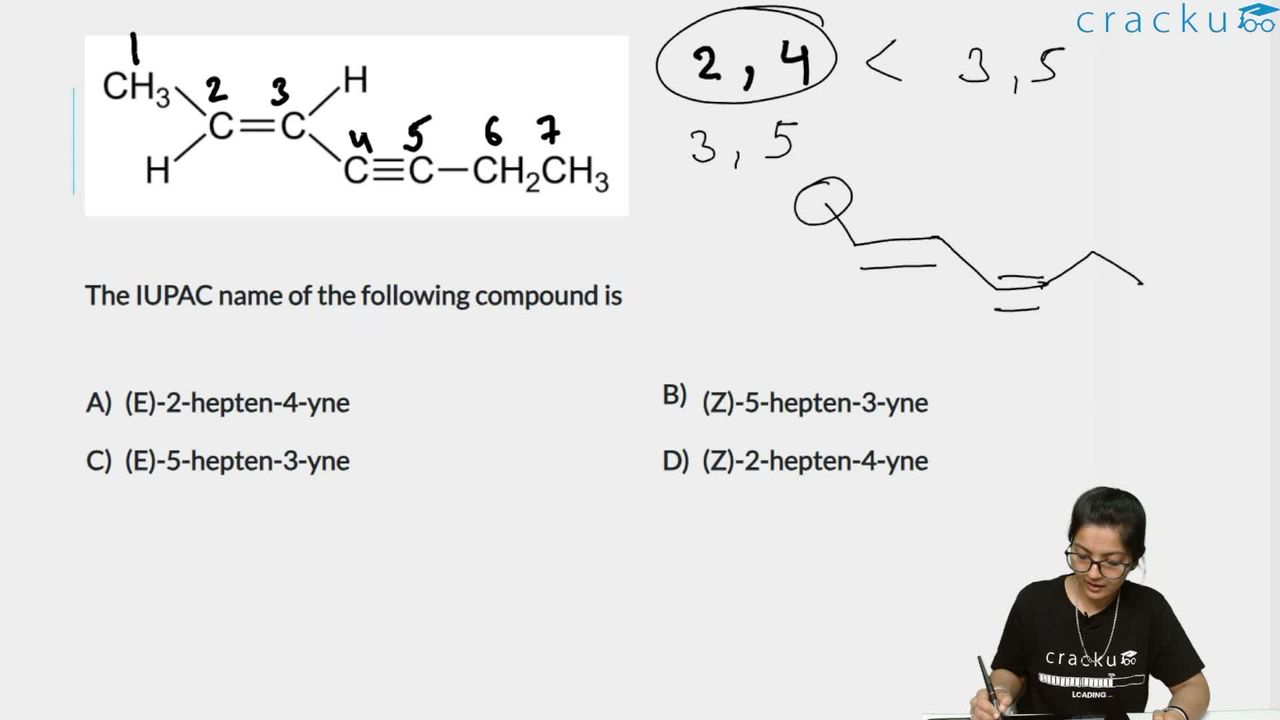
According to IUPAC rules, when a chain contains both double bonds (-ene) and triple bonds (-yne), the chain is numbered from the end that gives the lower locants to the multiple bonds overall, regardless of their nature.
Comparing the sets, (2, 4) is lower than (3, 5). Therefore, we number the chain from left to right:
$$\text{C1(H}_3) - \text{C2(H)} = \text{C3(H)} - \text{C4} \equiv \text{C5} - \text{C6(H}_2) - \text{C7(H}_3)$$
This places the double bond at carbon-2 (2-en) and the triple bond at carbon-4 (4-yne).
We look at the spatial arrangement across the double bond between carbon-2 and carbon-3 using the Cahn-Ingold-Prelog (CIP) priority rules:
Since the high-priority groups ($$-\text{CH}_3$$ on C2 and the alkynyl chain on C3) lie on opposite sides of the double bond, the configuration is entgegen ($$E$$), which signifies a trans orientation.
Combining the stereodescriptor, the 7-carbon root, and the indexed suffixes in alphabetical order (-en before -yne, dropping the terminal 'e' from -ene) gives:
$$\mathbf{(E)\text{-}2\text{-}hepten\text{-}4\text{-}yne}$$
The correct stereochemical and structural configuration assignment matches Option A.
Answer: Option A — (E)-2-hepten-4-yne
Was this solution helpful?
Click on the Email ☝️ to Watch the Video Solution
Create a FREE account and get:
_1.webp)

Educational materials for JEE preparation

Ask our AI anything

AI can make mistakes. Please verify important information.
AI can make mistakes. Please verify important information.