
Join Our JEE Preparation Group
Prep with like-minded aspirants; Get access to free daily tests and study material.
Sign in
Please select an account to continue using cracku.in
↓ →
Join Our JEE Preparation Group
Prep with like-minded aspirants; Get access to free daily tests and study material.
If $$K_{sp}$$ of CaF$$_2$$ at $$25^\circ C$$ is $$1.7\times 10^{-10}$$, the combination amongst the following which gives a precipitate of CaF$$_2$$ is
For calcium fluoride, the equilibrium in a saturated solution is
$$CaF_2(s) \rightleftharpoons Ca^{2+}(aq) + 2\,F^{-}(aq)$$
Its solubility product is defined as
$$K_{sp}= [Ca^{2+}][F^-]^2$$
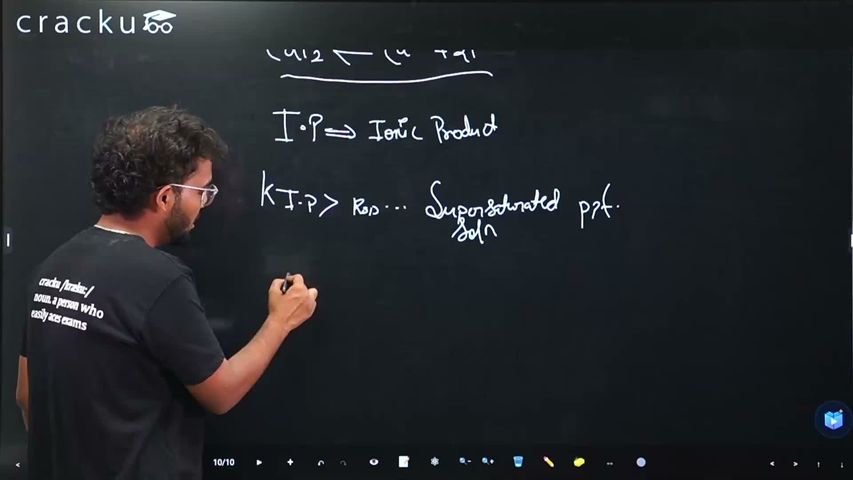
Whenever a solution actually contains $$Ca^{2+}$$ and $$F^-$$ ions, we calculate the ionic product
$$IP = [Ca^{2+}]_{\text{mixed}}\,[F^-]_{\text{mixed}}^{\,2}$$
Comparison rule:
• If $$IP \gt K_{sp}$$ → the solution is supersaturated and $$CaF_2$$ precipitates.
• If $$IP \le K_{sp}$$ → no precipitation.
Case 1: Option A
$$[Ca^{2+}] = 1 \times 10^{-2}\;M,\quad [F^-] = 1 \times 10^{-3}\;M$$
$$IP = (1\times10^{-2})\,(1\times10^{-3})^{2} = 1\times10^{-2}\times1\times10^{-6} = 1\times10^{-8}$$
$$1\times10^{-8} \gt 1.7\times10^{-10}$$, hence precipitation occurs.
Case 2: Option B
$$IP = (1\times10^{-4})\,(1\times10^{-4})^{2} = 1\times10^{-4}\times1\times10^{-8} = 1\times10^{-12}$$
$$1\times10^{-12} \lt 1.7\times10^{-10}$$, so no precipitate.
Case 3: Option C
$$IP = (1\times10^{-2})\,(1\times10^{-5})^{2} = 1\times10^{-2}\times1\times10^{-10} = 1\times10^{-12}$$
Again $$1\times10^{-12} \lt 1.7\times10^{-10}$$ → no precipitate.
Case 4: Option D
$$IP = (1\times10^{-3})\,(1\times10^{-5})^{2} = 1\times10^{-3}\times1\times10^{-10} = 1\times10^{-13}$$
$$1\times10^{-13} \lt 1.7\times10^{-10}$$ → no precipitate.
Only Case 1 satisfies $$IP \gt K_{sp}$$. Therefore the mixture that produces a $$CaF_2$$ precipitate is:
Option A which is: $$1\times10^{-2}$$ M Ca$$^{2+}$$ and $$1\times10^{-3}$$ M F$$^-$$
Was this solution helpful?
Click on the Email ☝️ to Watch the Video Solution
Create a FREE account and get:
_1.webp)

Educational materials for JEE preparation

Ask our AI anything

AI can make mistakes. Please verify important information.
AI can make mistakes. Please verify important information.
