Join WhatsApp Icon JEE WhatsApp Group
Question 41

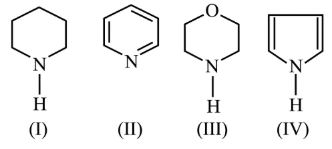
In the following compounds:

image

the order of basicity is as follows

Solution

The basic strength of an amine depends on how readily the lone pair on nitrogen can be donated to a proton. The main factors are:

(i) +I (inductive) effect of alkyl groups, which pushes electron density toward nitrogen and increases basicity.
(ii) Resonance (-M) withdrawal of the lone pair, which decreases basicity.
(iii) Additional electron-withdrawing substituents on the ring, which further lower electron density on nitrogen.

1. Piperidine (Compound I) — Most Basic

  • Structure: A fully saturated 6-membered ring containing nitrogen ($$sp^3$$ hybridized).
  • Basicity: It behaves like a typical secondary aliphatic amine. The alkyl groups surrounding the nitrogen push electron density toward it via the inductive effect (+I effect), making the lone pair highly available. It has the highest $$pK_a$$ ($$\approx 11.2$$).

2. Morpholine (Compound III)

  • Structure: Similar to piperidine, but it has an oxygen atom directly opposite the nitrogen atom.
  • Basicity: The nitrogen is still $$sp^3$$ hybridized, but oxygen is highly electronegative and pulls electron density away through the bonds via a -I (inductive) effect. This reduces the availability of the nitrogen's lone pair compared to piperidine, making it less basic ($$pK_a \approx 8.4$$).

3. Pyridine (Compound II)

  • Structure: An aromatic 6-membered ring where the nitrogen is part of the double-bond system ($$sp^2$$ hybridized).
  • Basicity: The lone pair on the nitrogen is not part of the aromatic $$\pi$$-system (it sits perpendicular to it in an $$sp^2$$ orbital), so it is available for bonding. However, because $$sp^2$$ orbitals have more s-character than $sp^3$ orbitals, they hold onto electrons more tightly. This makes pyridine significantly less basic than aliphatic amines ($$pK_a \approx 5.2$$).

4. Pyrrole (Compound IV) — Least Basic

  • Structure: An aromatic 5-membered ring.
  • Basicity: The lone pair on this nitrogen atom is actively involved in the aromatic ring system to satisfy Huckel's rule ($$6\pi$$ electrons). If this lone pair accepts a proton, the aromatic stability of the molecule is completely destroyed. Therefore, it is an extremely weak base ($$pK_a \approx -3.8$$).

Final Answer: Option D which is: I > III > II > IV

Get AI Help

Video Solution

video

Create a FREE account and get:

  • Free JEE Mains Previous Papers PDF
  • Take JEE Mains paper tests
Ask AI