
Join Our JEE Preparation Group
Prep with like-minded aspirants; Get access to free daily tests and study material.
Sign in
Please select an account to continue using cracku.in
↓ →
Join Our JEE Preparation Group
Prep with like-minded aspirants; Get access to free daily tests and study material.
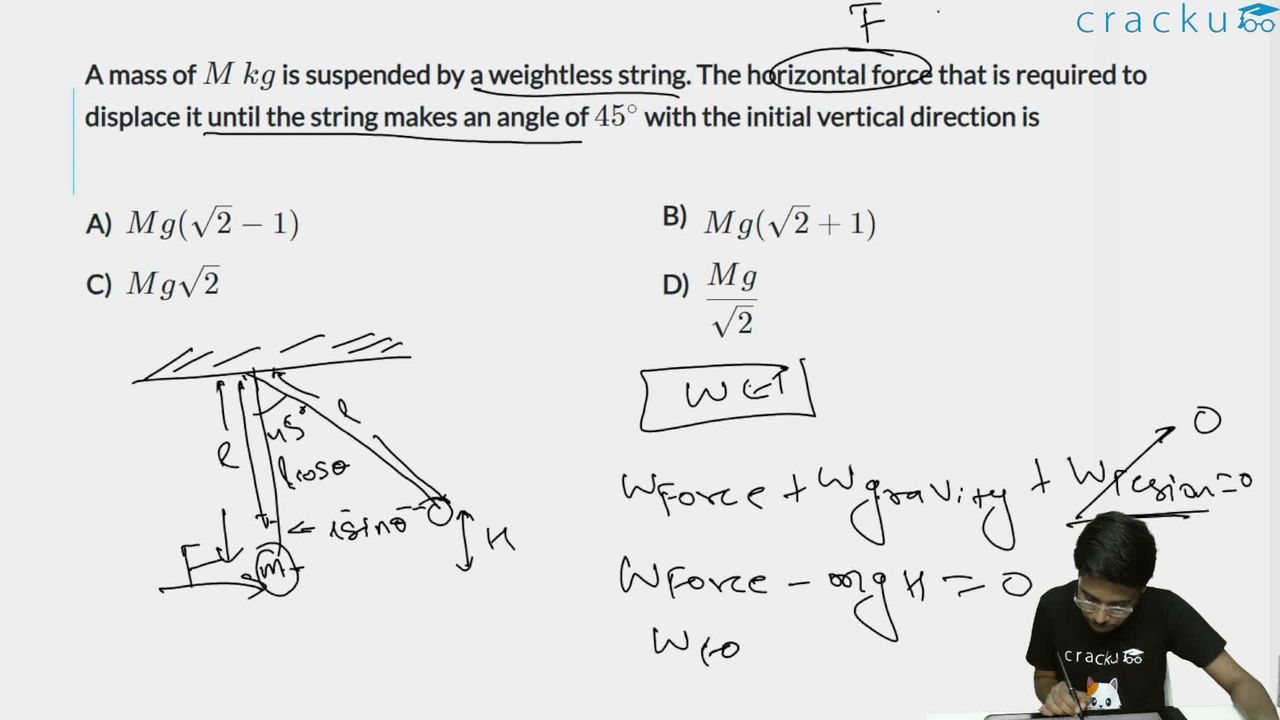
A mass of $$M\,kg$$ is suspended by a weightless string. The horizontal force that is required to displace it until the string makes an angle of $$45^\circ$$ with the initial vertical direction is
We need to find the horizontal force required to displace a mass $$M$$ suspended by a string until the string makes an angle of $$45^\circ$$ with the initial vertical direction.
When an external horizontal force $$F$$ displaces a pendulum slowly (quasi-statically), it keeps the system in static equilibrium at every instant. However, if a constant horizontal force is applied to a system starting from rest, the system does not remain in equilibrium; instead, it accelerates and reaches a position of maximum displacement where it momentarily comes to rest ($$\Delta K = 0$$). We can solve this cleanly using the Work-Energy Theorem.
Let $$L$$ be the length of the weightless string.
The vertical height ($$h$$) by which the mass is lifted upward against gravity is:
$$h = L - L \cdot \cos(45^\circ) = L \cdot (1 - \cos(45^\circ))$$
Substituting $$\cos(45^\circ) = \frac{1}{\sqrt{2}}$$ into the equation:
$$h = L \cdot \left(1 - \frac{1}{\sqrt{2}}\right)$$
The horizontal distance moved by the mass from its initial vertical alignment is given by the sine component of the string's length:
$$x = L \cdot \sin(45^\circ) = \frac{L}{\sqrt{2}}$$
According to the Work-Energy Theorem, the total work done by all forces acting on the body as it moves from its initial rest position to its maximum deflection position is equal to the change in its kinetic energy ($$\Delta K = 0$$):
$$W_{\text{net}} = \Delta K$$
$$W_{\text{Force}} + W_{\text{gravity}} + W_{\text{tension}} = 0$$
Since the string's tension always acts perpendicular to the instantaneous path of displacement, the work done by tension is zero ($$W_{\text{tension}} = 0$$). The work done by gravity during the height increase is $$-Mgh$$. Therefore:
$$W_{\text{Force}} - Mgh = 0 \implies W_{\text{Force}} = Mgh$$
Substituting our expression for height ($$h$$):
$$W_{\text{Force}} = MgL \cdot \left(1 - \frac{1}{\sqrt{2}}\right) \quad \text{--- (Eq. 1)}$$
Since the applied horizontal force $$F$$ remains constant in both magnitude and direction, the work done by it is simply the product of the force and the total horizontal displacement ($$x$$):
$$W_{\text{Force}} = F \cdot x = F \cdot \left(\frac{L}{\sqrt{2}}\right) \quad \text{--- (Eq. 2)}$$
Equating Equation 1 and Equation 2:
$$F \cdot \left(\frac{L}{\sqrt{2}}\right) = MgL \cdot \left(1 - \frac{1}{\sqrt{2}}\right)$$
Cancel out the string length $$L$$ from both sides:
$$\frac{F}{\sqrt{2}} = Mg \cdot \left(1 - \frac{1}{\sqrt{2}}\right)$$
Multiply both sides by $$\sqrt{2}$$ to isolate $$F$$:
$$F = Mg \cdot \sqrt{2} \cdot \left(1 - \frac{1}{\sqrt{2}}\right)$$
$$F = Mg(\sqrt{2} - 1)$$
Concept Check: The work performed by our external pulling force goes entirely into storing gravitational potential energy within the system ($$U = Mgh$$). At exactly $$45^\circ$$, the scaling factor resolves perfectly to an extra factor of $$\sqrt{2}-1$$ times the static weight of the block.
Correct Option Key: Option A ($$Mg(\sqrt{2} - 1)$$)
Was this solution helpful?
Click on the Email ☝️ to Watch the Video Solution
Create a FREE account and get:
_1.webp)

Educational materials for JEE preparation

Ask our AI anything

AI can make mistakes. Please verify important information.
AI can make mistakes. Please verify important information.
