
Join Our JEE Preparation Group
Prep with like-minded aspirants; Get access to free daily tests and study material.
Sign in
Please select an account to continue using cracku.in
↓ →
Join Our JEE Preparation Group
Prep with like-minded aspirants; Get access to free daily tests and study material.
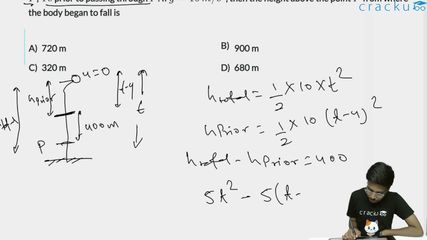
A body falling from rest under gravity passes a certain point $$P$$. It was at a distance of $$400\,m$$ from $$P$$, $$4\,s$$ prior to passing through $$P$$. If $$g = 10\,m/s^2$$, then the height above the point $$P$$ from where the body began to fall is
Let us break down the journey of the falling body from its starting position down to point $$P$$:
$$u = 0 \,\, \text{m/s}$$
Using the second equation of motion ($$s = u \cdot t + \frac{1}{2} \cdot g \cdot t^2$$) with $$u = 0$$ and acceleration due to gravity $$g = 10 \,\, \text{m/s}^2$$:
$$h_{\text{total}} = \frac{1}{2} \cdot g \cdot t^2 = \frac{1}{2} \cdot 10 \cdot t^2 = 5t^2 \quad \text{--- (Eq. 1)}$$
$$h_{\text{prior}} = \frac{1}{2} \cdot g \cdot (t - 4)^2 = \frac{1}{2} \cdot 10 \cdot (t - 4)^2 = 5(t - 4)^2 \quad \text{--- (Eq. 2)}$$
We are given that the distance between this prior point and point $$P$$ is exactly $$400 \,\, \text{m}$$. Therefore:
$$h_{\text{total}} - h_{\text{prior}} = 400$$
Substitute Equation 1 and Equation 2 into this relationship:
$$5t^2 - 5(t - 4)^2 = 400$$
Divide the entire equation by 5 to simplify the algebra:
$$t^2 - (t - 4)^2 = 80$$
Expand the squared binomial term using $$(a-b)^2 = a^2 - 2ab + b^2$$:
$$t^2 - (t^2 - 8t + 16) = 80$$
$$t^2 - t^2 + 8t - 16 = 80$$
$$8t - 16 = 80$$
Isolate the time variable ($$t$$):
$$8t = 80 + 16$$
$$8t = 96 \implies t = \frac{96}{8} = 12 \,\, \text{s}$$
Now that we know the total falling duration to reach point $$P$$ is $$12 \,\, \text{seconds}$$, we substitute $$t = 12$$ back into Equation 1 to find the initial bailing height:
$$h_{\text{total}} = 5 \cdot (12)^2$$
$$h_{\text{total}} = 5 \cdot 144 = 720 \,\, \text{m}$$
Concept Check: Falling for $$12 \,\, \text{s}$$ under gravity covers $$720 \,\, \text{m}$$. At $$8 \,\, \text{s}$$ ($$4 \,\, \text{s}$$ prior), the body covers $$5 \times 8^2 = 320 \,\, \text{m}$$. The difference between them ($$720 - 320 = 400 \,\, \text{m}$$) perfectly matches our problem statement.
Correct Option Key: A (720 m)
Was this solution helpful?
Click on the Email ☝️ to Watch the Video Solution
Create a FREE account and get:
_1.webp)

Educational materials for JEE preparation

Ask our AI anything

AI can make mistakes. Please verify important information.
AI can make mistakes. Please verify important information.
