
Join Our JEE Preparation Group
Prep with like-minded aspirants; Get access to free daily tests and study material.
Sign in
Please select an account to continue using cracku.in
↓ →
Join Our JEE Preparation Group
Prep with like-minded aspirants; Get access to free daily tests and study material.
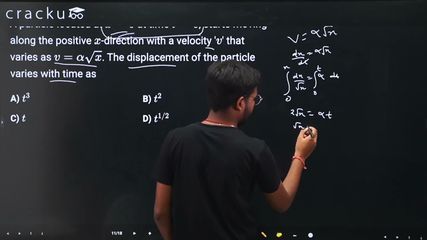
A particle located at $$x = 0$$ at time $$t = 0$$, starts moving along the positive $$x$$-direction with a velocity '$$v$$' that varies as $$v = \alpha\sqrt{x}$$. The displacement of the particle varies with time as
We are given that the velocity ($$v$$) of the particle varies with its position ($$x$$) according to the relation:
$$v = \alpha \sqrt{x}$$
Velocity is defined as the instantaneous rate of change of displacement with respect to time ($$v = \frac{dx}{dt}$$). Substituting this definition into our given equation gives a separable differential equation:
$$\frac{dx}{dt} = \alpha \sqrt{x}$$
To solve for displacement as a function of time, we rearrange the terms to group all $$x$$ variables on one side and all $$t$$ variables on the other:
$$\frac{dx}{\sqrt{x}} = \alpha \cdot dt$$
$$x^{-\frac{1}{2}} \cdot dx = \alpha \cdot dt$$
Now, we integrate both sides using the given initial boundary conditions (at time $$t = 0$$, the particle is located at $$x = 0$$):
$$\int_{0}^{x} x^{-\frac{1}{2}} \cdot dx = \int_{0}^{t} \alpha \cdot dt$$
Applying the power rule of integration ($$\int x^n dx = \frac{x^{n+1}}{n+1}$$):
$$\left[ \frac{x^{\frac{1}{2}}}{\frac{1}{2}} \right]_{0}^{x} = \alpha \cdot [t]_{0}^{t}$$
$$2\sqrt{x} = \alpha \cdot t$$
Isolate the radical term by dividing both sides by 2:
$$\sqrt{x} = \frac{\alpha \cdot t}{2}$$
Square both sides of the equation to clear the square root and find the explicit displacement function:
$$x = \left( \frac{\alpha \cdot t}{2} \right)^2$$
$$x = \frac{\alpha^2}{4} \cdot t^2$$
Since $$\alpha$$ is a constant value, the coefficient fraction $$\frac{\alpha^2}{4}$$ is also entirely constant. Dropping the constants reveals the final scaling relationship between displacement and time:
$$x \propto t^2$$
Concept Check: Because velocity scales with the square root of position, the acceleration of this system turns out to be perfectly uniform ($$a = v \frac{dv}{dx} = \alpha \sqrt{x} \cdot \frac{\alpha}{2\sqrt{x}} = \frac{\alpha^2}{2}$$). Under constant acceleration starting from rest, displacement naturally expands quadratically with the square of elapsed time ($$x \propto t^2$$).
Correct Option Key: Option B ($$t^2$$)
Was this solution helpful?
Click on the Email ☝️ to Watch the Video Solution
Create a FREE account and get:
_1.webp)

Educational materials for JEE preparation

Ask our AI anything

AI can make mistakes. Please verify important information.
AI can make mistakes. Please verify important information.
