
Join Our JEE Preparation Group
Prep with like-minded aspirants; Get access to free daily tests and study material.
Sign in
Please select an account to continue using cracku.in
↓ →
Join Our JEE Preparation Group
Prep with like-minded aspirants; Get access to free daily tests and study material.
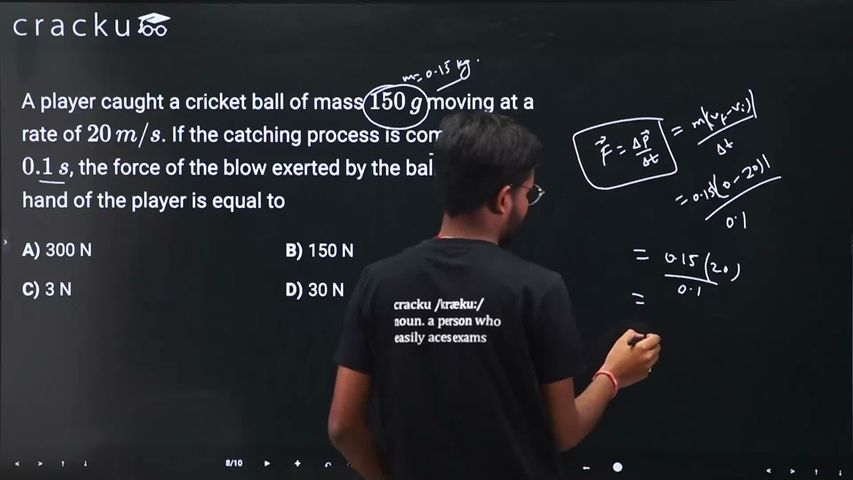
A player caught a cricket ball of mass $$150\,g$$ moving at a rate of $$20\,m/s$$. If the catching process is completed in $$0.1\,s$$, the force of the blow exerted by the ball on the hand of the player is equal to
We are given the following values from the problem statement:
First, we convert the mass from grams to kilograms (SI units):
$$m = \frac{150}{1000} = 0.15 \,\, \text{kg}$$
According to Newton's Second Law of Motion, the average force ($$F$$) exerted on an object is equal to its rate of change of linear momentum ($$\Delta P$$):
$$F = \frac{\Delta P}{\Delta t} = \frac{m \cdot v - m \cdot u}{\Delta t}$$
Since we are calculating the magnitude of the force of the blow:
$$|F| = \frac{m \cdot |v - u|}{\Delta t}$$
Substituting the parameters into our equation:
$$|F| = \frac{0.15 \cdot |0 - 20|}{0.1}$$
$$|F| = \frac{0.15 \cdot 20}{0.1}$$
$$|F| = \frac{3.0}{0.1} = 30 \,\, \text{N}$$
Concept Check: Extending the catching process duration ($$\Delta t$$) allows the momentum to change over a longer period, which drastically reduces the impact force felt by the player's hand. If caught instantaneously, the force would be significantly more punishing.
Correct Option Key: 30 N
Was this solution helpful?
Click on the Email ☝️ to Watch the Video Solution
Create a FREE account and get:
_1.webp)

Educational materials for JEE preparation

Ask our AI anything

AI can make mistakes. Please verify important information.
AI can make mistakes. Please verify important information.
