
Join Our JEE Preparation Group
Prep with like-minded aspirants; Get access to free daily tests and study material.
Sign in
Please select an account to continue using cracku.in
↓ →
Join Our JEE Preparation Group
Prep with like-minded aspirants; Get access to free daily tests and study material.
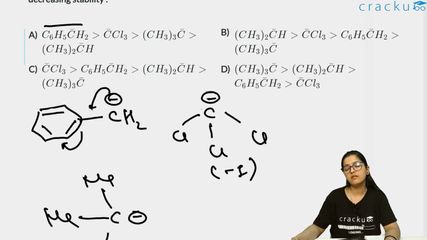
Arrange the carbanions, $$(CH_3)_3\bar{C}, \bar{C}Cl_3, (CH_3)_2\bar{C}H, C_6H_5\bar{C}H_2$$, in order of their decreasing stability :
A carbanion carries a negative charge on carbon. Its stability is governed mainly by two factors:
1. Electron-withdrawing effects (−I/−M) and resonance delocalisation that can disperse the negative charge - these increase stability.
2. Electron-donating +I/+H (hyperconjugation) effects of alkyl groups that push electron density towards an already negative carbon - these decrease stability.
Let us examine each species.
Case 1: $$\bar{C}Cl_3$$ (trichloromethyl carbanion)
Each chlorine has a strong −I (inductive electron-withdrawing) effect. Three such groups pull electron density away from the carbanionic carbon and greatly stabilise the charge. No competing +I groups are present. Hence this is expected to be the most stable of the given set.
Case 2: $$C_6H_5\bar{C}H_2$$ (benzyl carbanion)
The lone pair on the carbanionic carbon can overlap with the π-system of the benzene ring. Consequently, the negative charge is delocalised over the ring via resonance: $$\bar{C}H_2 - C_6H_5 \;\rightleftharpoons\; CH_2 = C_6H_5\bar{}$$ etc. This resonance dispersion strongly stabilises the anion. Although the phenyl ring is weakly −I/−M overall, the resonance delocalisation dominates, making the benzyl anion highly stable, but still somewhat less than $$\bar{C}Cl_3$$ where three strong −I groups act continuously.
Case 3: $$(CH_3)_2\bar{C}H$$ (isopropyl carbanion)
Two methyl groups exert a +I effect and also offer hyperconjugation. Both donate electron density, which destabilises the already negative carbon. With only two methyls this destabilisation is moderate.
Case 4: $$(CH_3)_3\bar{C}$$ (tert-butyl carbanion)
Here three methyl groups donate electron density (+I and +H) to the carbanionic carbon. This is the maximum alkyl electron donation among the given examples, so it is the least stable of the four.
Combining the analyses:
$$\bar{C}Cl_3 \; \gt \; C_6H_5\bar{C}H_2 \; \gt \; (CH_3)_2\bar{C}H \; \gt \; (CH_3)_3\bar{C}$$
Thus the correct decreasing stability order matches Option C.
Final Answer: Option C which is: $$\bar{C}Cl_3 > C_6H_5\bar{C}H_2 > (CH_3)_2\bar{C}H > (CH_3)_3\bar{C}$$
Was this solution helpful?
Click on the Email ☝️ to Watch the Video Solution
Create a FREE account and get:
_1.webp)

Educational materials for JEE preparation

Ask our AI anything

AI can make mistakes. Please verify important information.
AI can make mistakes. Please verify important information.
